Enterprise Risk Management
Enterprise Risk Management Consulting: Costs and How to Choose a Firm
What these engagements cost in the mid-market, what you should receive, and how to tell a practitioner from a salesperson before you sign.
By Eric Kennedy · Originally published Tue Apr 07 2026 · Updated Thu Sep 10 2026 · 14 min read

Enterprise risk management consulting is advisory work that helps a company identify the risks that could derail its plan, assign an owner to each one, and build the reporting rhythm that puts those risks in front of the people who make decisions. For a company between $50M and $750M in revenue, a program diagnostic typically runs $4,500 to $6,500, a targeted assessment $22,000 to $27,000, and a full program build $52,000 to $70,000.
The harder question is not what ERM consulting is. It is which firm to hire, and how to tell a practitioner from a salesperson before you have signed anything.
COSO's Enterprise Risk Management guidance frames effective ERM as connecting risk appetite directly to strategic decision-making rather than running it as a compliance exercise. Most firms will tell you that. Fewer will tell you what it costs, who does the work week to week, or what you are left holding when they leave.
This guide covers what these engagements actually cost in the mid-market, the red flags that show up in the first two conversations, ten questions that separate a practitioner from a salesperson, and the five components any credible program has to contain.
Which Type of ERM Consulting Firm Is Right for a Growing Company?
Before comparing fees, decide which shape of firm fits the problem you are solving. Three types dominate the market, and each one is the right answer for a different company.
| Firm type | Best fit | Main tradeoff |
|---|---|---|
| Global multidisciplinary firm | Multinational, heavily regulated, or multi-jurisdictional transformations | Higher cost and less senior continuity |
| Industry specialist | Deep sector-specific regulatory or operational exposure | Less cross-enterprise breadth |
| Senior-led ERM boutique | Mid-market companies that need a practical program build and direct senior involvement | Smaller global bench |
Kennedy Risk Group is designed for companies between $50 million and $750 million that need a senior-led diagnostic, enterprise risk assessment, or practical ERM program build. Companies requiring a large, multi-country regulatory transformation may be better served by a global firm.
Building ERM as your company grows?
See how KRG builds a practical operating model for risk identification, ownership, reporting, and board oversight.
Explore the ERM Foundation Build Start with the ERM Diagnostic
What ERM Consulting Costs in the Mid-Market
For a mid-market company, ERM consulting typically runs $4,500 to $6,500 for a program diagnostic, $18,000 to $27,000 for a targeted assessment or an executive reporting build, and $52,000 to $70,000 for a full ERM program build. Most published cost ranges for ERM consulting describe large-enterprise engagements, where multi-entity structures, multiple jurisdictions, and layered internal governance drive scope and price well above what a company between $50M and $750M in revenue actually needs.
| Engagement | Best fit | Typical fee | Timeline |
|---|---|---|---|
| ERM program diagnostic | Leadership knows something is missing but not what | $4,500 to $6,500 | 1 to 2 weeks |
| Executive risk reporting build | A register exists but the board cannot use it | $18,000 to $25,000 | 3 to 6 weeks |
| Targeted risk assessment | Risks have never been consolidated or ranked | $22,000 to $27,000 | 4 to 6 weeks |
| Full ERM program build | The company needs a repeatable operating model | $52,000 to $70,000 | 8 to 12 weeks |
Ranges reflect Kennedy Risk Group's current fixed-fee service design for mid-market companies.
Three things account for the difference. Scope: a mid-market risk universe is typically 15 to 25 enterprise risks across one or two operating entities, not several hundred across a dozen. Delivery model: the work is performed by one senior practitioner rather than a partner, an engagement manager, and a team of analysts, which removes the leverage margin that sets large-firm pricing. Software: these figures cover advisory work only. GRC platform licensing is frequently bundled into published ERM cost figures and can exceed the consulting fee itself.
A lower price does not mean lighter work. It means the scope is matched to the decisions a mid-market leadership team actually has to make.
If you are not sure which of these fits, the ERM Program Diagnostic is built to answer that question before you commit to anything larger.
How to Evaluate an ERM Consulting Firm
Most selection processes weigh brand and price. Neither predicts whether you end up with a working program. Score each firm you are considering across these six dimensions before you sign anything.
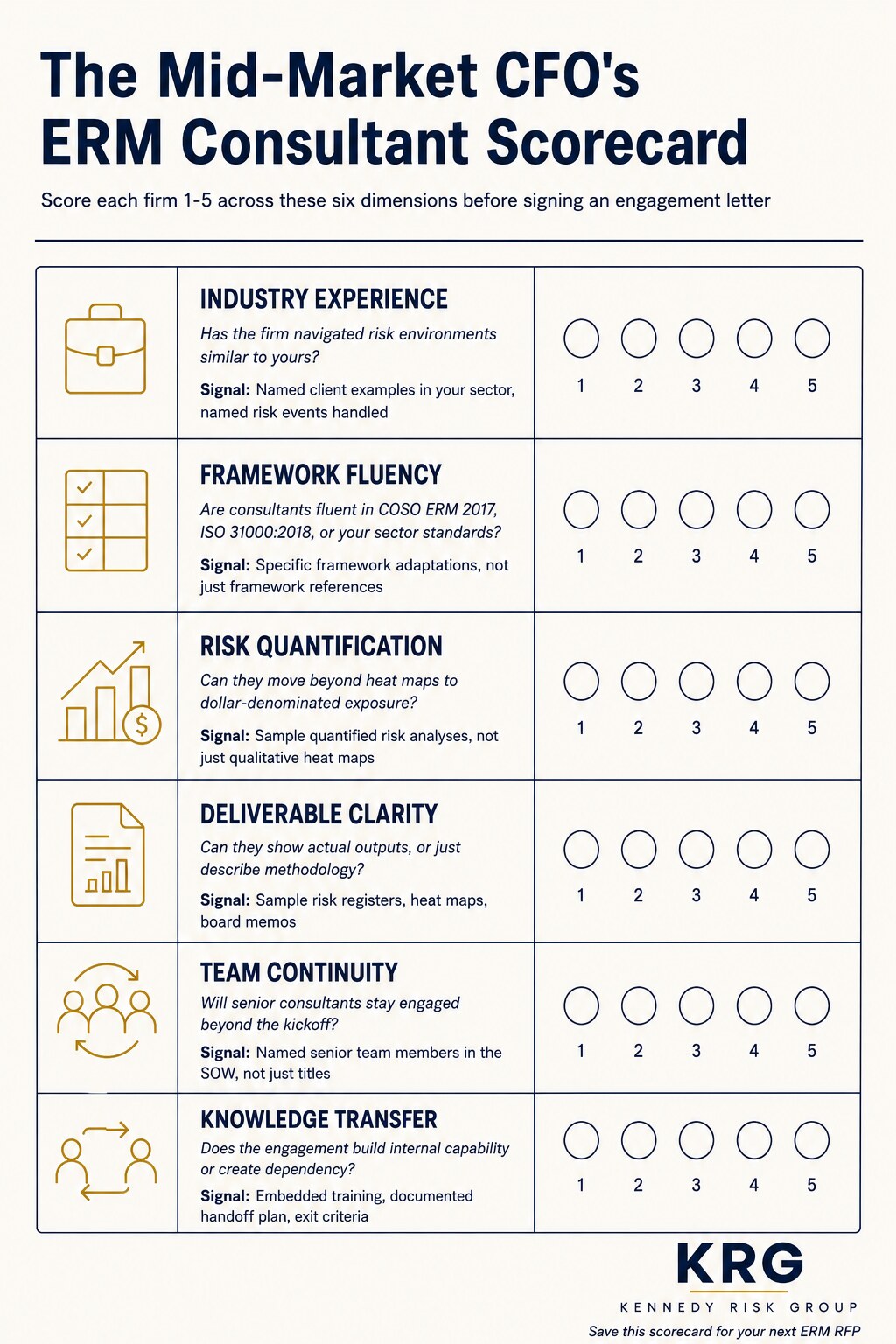
1. Industry experience. Has the firm worked in risk environments like yours, and can they explain the risk events they handled and what changed as a result? There is a difference between advising on a risk program and being accountable for running one. Ask whether the people doing the work have owned the operating cadence, challenged risk owners, and reported results to executives or a board.
2. Framework fluency. A firm should understand the standards that fit your context: COSO ERM 2017 for integrating risk with strategy, ISO 31000:2018 for broader operational and international applications, NIST frameworks for security, privacy, and cyber supply-chain risk, and sector standards such as NAIC ORSA or FFIEC where they apply. More frameworks are not necessarily better. The IIA's Three Lines Model is a useful test here. A good firm can explain where management, oversight, and assurance sit in your specific structure. A weak one recites the diagram.
3. Risk quantification. Can the firm move beyond heat maps when the decision requires it, using exposure ranges, scenarios, or dollar estimates? The objective is not to force a precise number onto every risk. It is to give leadership enough information to compare exposures, weigh responses, and allocate resources.
4. Deliverable clarity. Ask to see sanitized examples of actual outputs: a risk register, a board memo, a heat map with calibrated thresholds. If a firm can describe its methodology but cannot show how that methodology becomes a usable executive deliverable, you are being asked to buy a promise. The outputs should also be tools your team can maintain, not static reports that age out in a quarter.
5. Team continuity. Firms often win mid-market work with senior people in the room, then shift execution to staff two levels down once the SOW is signed. Get named individuals and their expected involvement into the SOW, not just senior titles in the proposal.
6. Knowledge transfer. Does the engagement build internal capability or create dependency? A program only survives if someone inside the company owns it and continues to evolve it after the external advisors leave. If the proposal does not explain how your team will operate the program without them, assume that dependency is part of the delivery model.
Three models, three trade-offs
Firms tend to fall into three shapes, and each buys you something at a cost.
Framework-first firms anchor their work to standards such as COSO ERM or ISO 31000. The approach is consistent and auditable, which matters under regulatory scrutiny. Applied without customization, however, it can produce documentation that sits on a shelf.
Industry specialists bring vertical depth and shorten the learning curve. Their narrower focus can limit their ability to address cross-functional exposures or broader risk-culture problems.
Integrated advisory firms combine risk, compliance, and internal audit capabilities under one roof, reducing coordination friction. Mid-market companies with lean teams may benefit from having one partner coordinate several related workstreams.
Only 11 percent of senior finance leaders view their organization's risk process as mostly or extensively a strategic tool that delivers competitive advantage, according to the AICPA and NC State 2025 State of Risk Oversight Report. The firms worth hiring are the ones that can explain how they close that gap in your business, not which of the three models they belong to.
Test before you commit
Request a paid discovery engagement before signing anything larger. A short, fixed-fee piece of work shows how a firm thinks, communicates, and handles ambiguity far more clearly than a proposal does.
What to expect even from a good firm
Three constraints are worth agreeing on before contracts are signed.
Scope discipline. Costs rise quickly when deliverables and decision rights are not bounded in writing.
Cultural fit. Technically sound recommendations still fail when the firm cannot earn trust or operate within the company's context.
Implementation reality. Timelines extend when governance is complex, ownership is contested, or decisions require several layers of approval.
None of that argues against hiring outside help. It argues for bounding the engagement before it starts.
Red flags when selecting an ERM consulting partner
Most bad engagements announce themselves early. After sixteen years working across internal audit, enterprise risk, finance, and transformation inside one Fortune 50 company, these are the warning signs I would act on if I were the buyer.
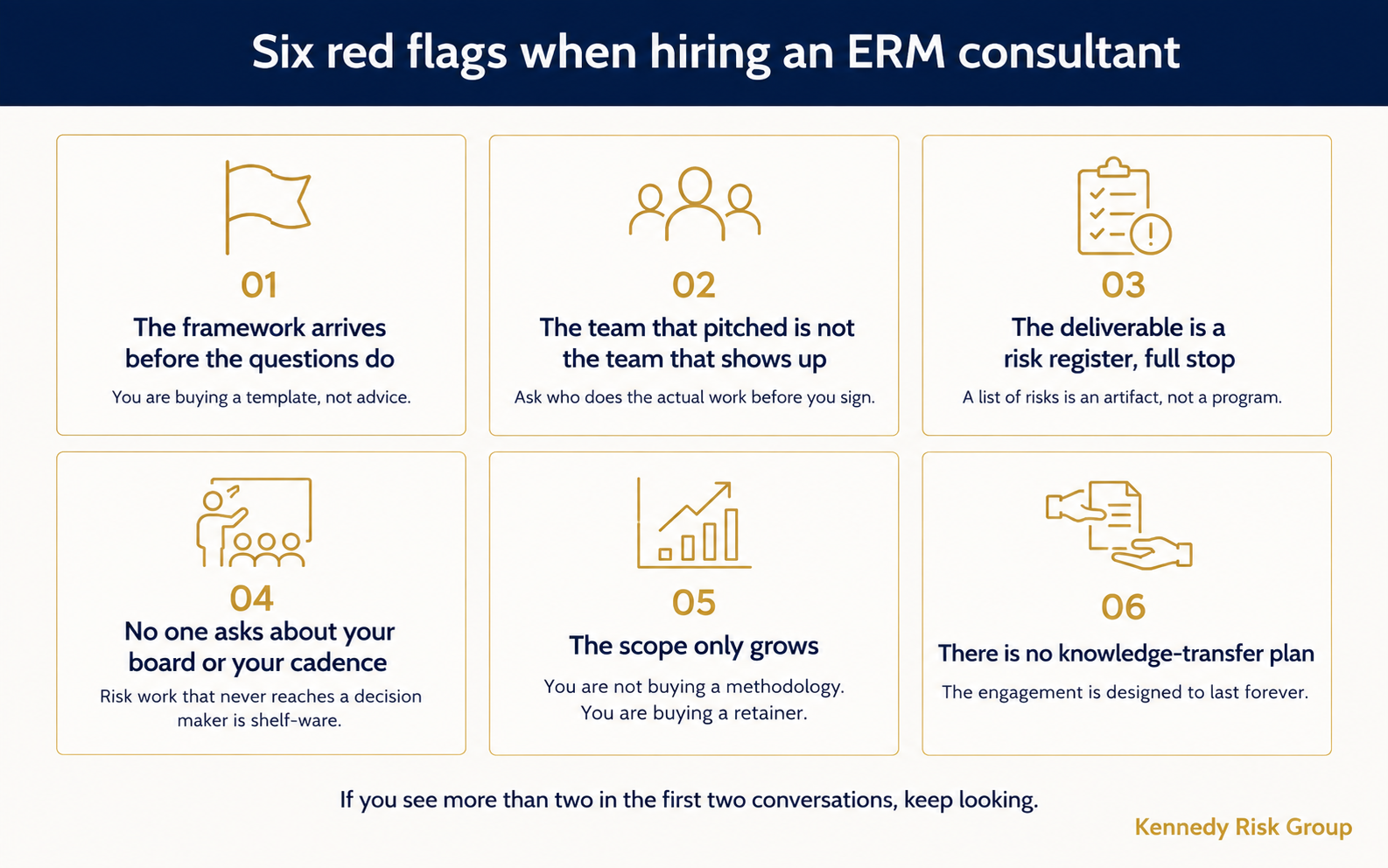
- The framework arrives before the questions do. If the proposal leads with COSO or ISO 31000 before anyone has asked how your company makes money, you are buying a template, not advice. The framework should serve your decisions, not the other way around.
- The team that pitched is not the team that shows up. A partner sells the engagement, then hands it to people two levels down who are learning your industry on your invoice. Ask who does the actual work before you sign.
- The deliverable is a risk register, full stop. A list of risks with heat-map colors is a starting artifact, not a program. If the engagement ends when the register is delivered, nothing about how your company operates will have changed.
- No one asks about your board or your reporting cadence. Risk work that never reaches a decision-maker is shelf-ware. A serious firm asks early who will see the output, how often, and what decisions it should inform.
- The scope only grows. If every conversation surfaces a new workstream and no one is willing to bound the engagement, you are not buying a methodology. You are buying a retainer.
- There is no knowledge-transfer plan. If the proposal does not explain how your team will run the program after the consultants leave, the engagement is designed to last forever.
If you see more than two of these in the first two conversations, keep looking. The right partner will feel like an extension of your leadership team, not a vendor managing a statement of work.
10 questions to ask an ERM consultant on the first call
The fastest way to separate a practitioner from a salesperson is to ask questions they cannot answer with generic slides. These ten questions force specificity on methodology, accountability, and outcomes.
- What does a finished risk program look like in your model? You want a clear picture of the operating rhythm (risk register, heat map, board reporting cadence, owner accountability), not a list of frameworks.
- How do you quantify risk exposure? Look for dollar-denominated or scenario-based analysis, not just likelihood and impact labels.
- Who exactly will be in the room week to week? Titles matter less than named individuals and their relevant experience.
- How do you transfer knowledge to our team? The engagement should leave your people more capable, not more dependent.
- What does a board-ready risk report from you look like? Ask for an actual sample. If they cannot show one, they have not done this at the level you need.
- How do you handle risks that fall between functions? Cross-functional ownership gaps are where most ERM programs fail. A good consultant has a model for this.
- What happens after the initial build is done? You want a clear transition to an internal operating rhythm, not a permanent advisory seat.
- Can you give a specific example of a risk you helped a client avoid or reduce? Vague case studies are a signal. Named patterns, even anonymized, are better.
- How do you measure whether the program is working a year from now?
- If we only had budget for one thing this year, what would you tell us to do?
The pattern to watch for in the answers is specificity. A practitioner answers with examples and numbers. A salesperson answers with frameworks. If you want to see how KRG would structure the work, the ERM Program Diagnostic is the lowest-commitment starting point: a short, fixed-fee review designed to clarify gaps, priorities, and the right next step before a larger commitment.
Why Your Organization Needs ERM Consulting
If you are earlier than that, the question is not which firm but whether you need one at all. What follows is how to tell.
The business environment has grown measurably more complex. Regulatory expectations are tightening, supply chains remain volatile, and cyber threats are escalating in both frequency and sophistication. For mid-market organizations, these compounding pressures make structured risk management services not a luxury, but a strategic necessity.
What typically happens is that organizations attempt to manage risk in silos: finance owns financial risk, IT owns cyber risk, operations owns process risk. The result is a fragmented view that leaves dangerous gaps unaddressed. Organizations without an integrated view are more exposed to cascading failures, where one unmanaged risk triggers several others at once and no single function sees it coming.
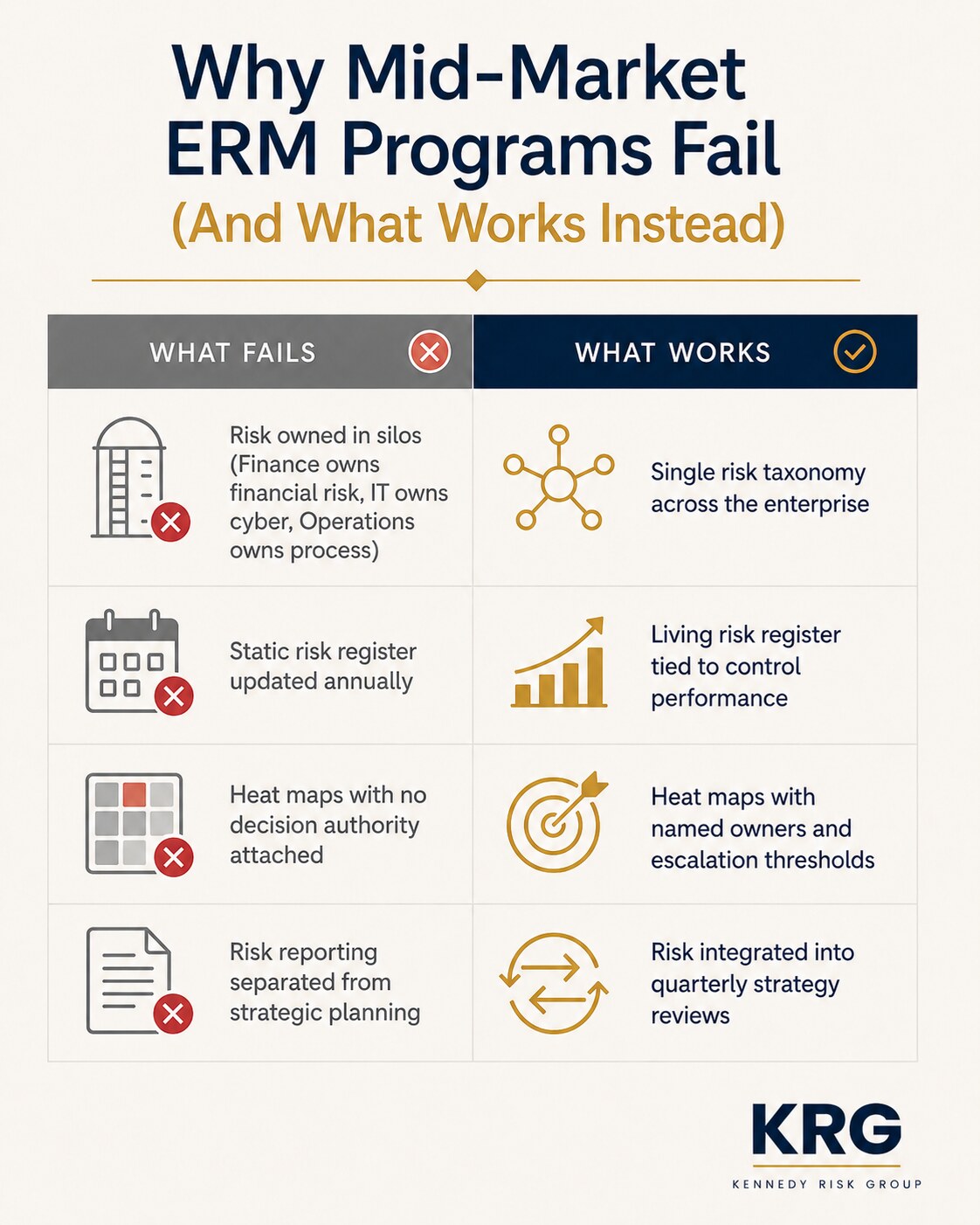
This is precisely where external ERM consultants add distinct value. They bring cross-industry pattern recognition, objective assessments free from internal politics, and proven frameworks that internal teams often lack the bandwidth to develop independently.
A well-structured ERM program doesn't just protect an organization. It creates the risk intelligence leadership needs to make faster, more confident strategic decisions.
However, not every organization requires the same level of engagement. Some need a full program build; others need targeted assessments or board-level reporting improvements. Recognizing which category you fall into is the first step. The second is knowing what a finished program should actually contain.
Exploring the 5 Components of ERM
If you are going to hold a firm to a standard, it helps to know what a working program actually contains. These five capabilities are what the engagement should leave behind, regardless of who builds them.
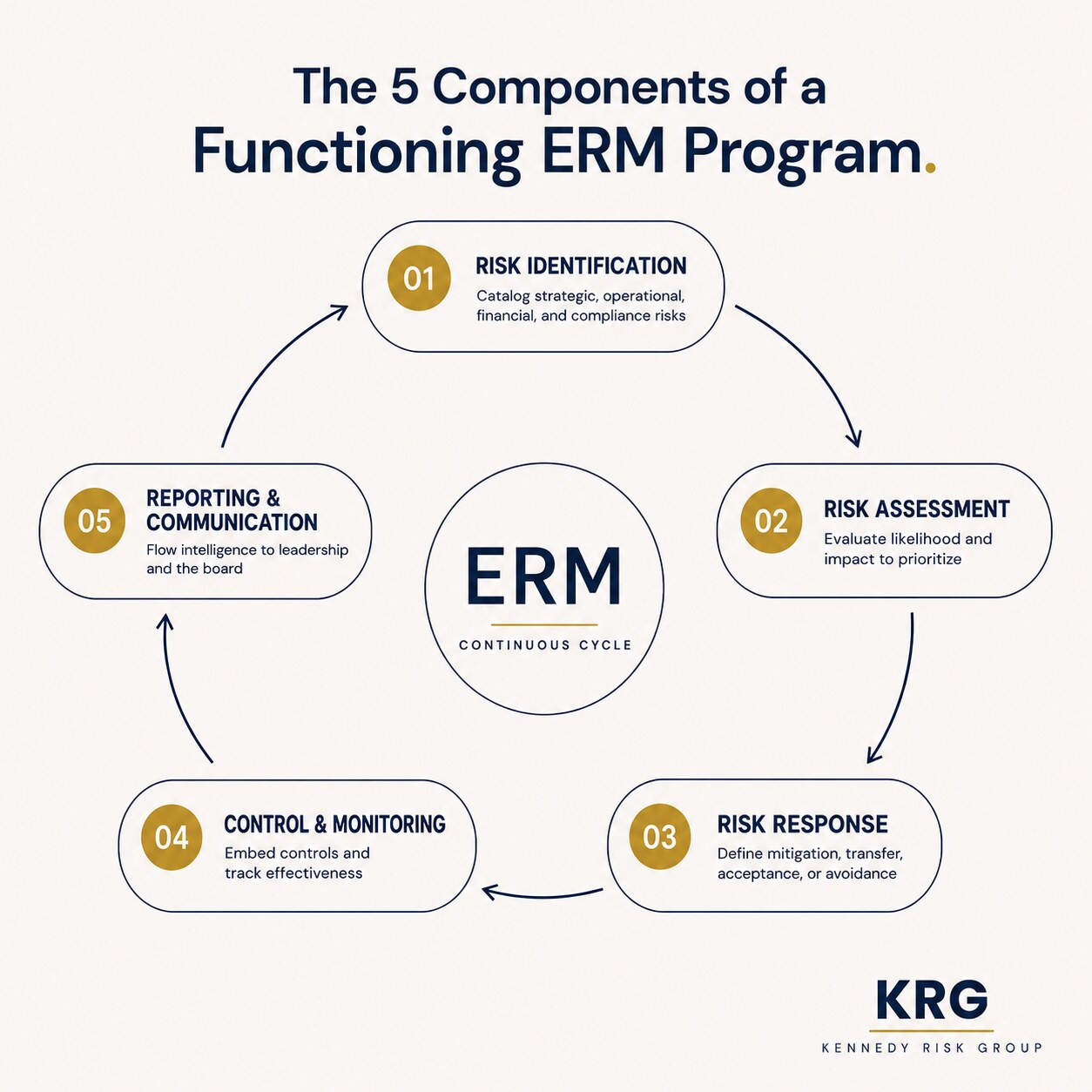
Different ERM frameworks (COSO 2017, ISO 31000:2018, NIST RMF) use different language, but they share a common underlying model. Most well-structured ERM programs operate across these five interconnected capabilities, working continuously rather than sequentially:
- Risk Identification: Systematically cataloging strategic, operational, financial, and compliance risks across the enterprise
- Risk Assessment: Evaluating likelihood and impact to prioritize where attention and resources belong
- Risk Response: Defining mitigation, transfer, acceptance, or avoidance strategies for each identified risk
- Control Activities & Monitoring: Embedding controls into daily operations and tracking their effectiveness over time
- Reporting & Communication: Ensuring risk intelligence flows clearly to leadership, the board, and relevant stakeholders
These aren't five steps to complete and check off. They form a continuous capability cycle: risks identified in any quarter feed reassessment in the next, controls flex as the business evolves, and reporting drives the conversations that surface new risks. The most common mid-market mistake is treating ERM as a one-time build instead of an ongoing operating rhythm.
Companies that run these five as one connected system, rather than as separate departmental exercises, tend to see disruption coming instead of reacting to it.
Internal audit services play a critical role within this structure, particularly in the monitoring and reporting phases. A strong ERM consulting engagement should account for how your internal audit function will intersect with ongoing risk activities, ensuring that audit findings directly inform risk priorities rather than existing as a separate reporting track.
The constructed example that follows shows how these five capabilities would come together in a mid-market build.
Illustrative ERM Foundation Build
ILLUSTRATIVE SCENARIO. The following is a constructed example built to show how the work is sequenced. It is not a Kennedy Risk Group client engagement, and it is not a promise of results.
Setup: A mid-market manufacturer with $400M in annual revenue has risk processes scattered across finance, operations, and compliance. Leadership can name exposures individually but has no consolidated view to prioritize them or bring them to the board.
An ERM Foundation Build for a company in that position runs 8 to 12 weeks. One plausible 10-week sequence:
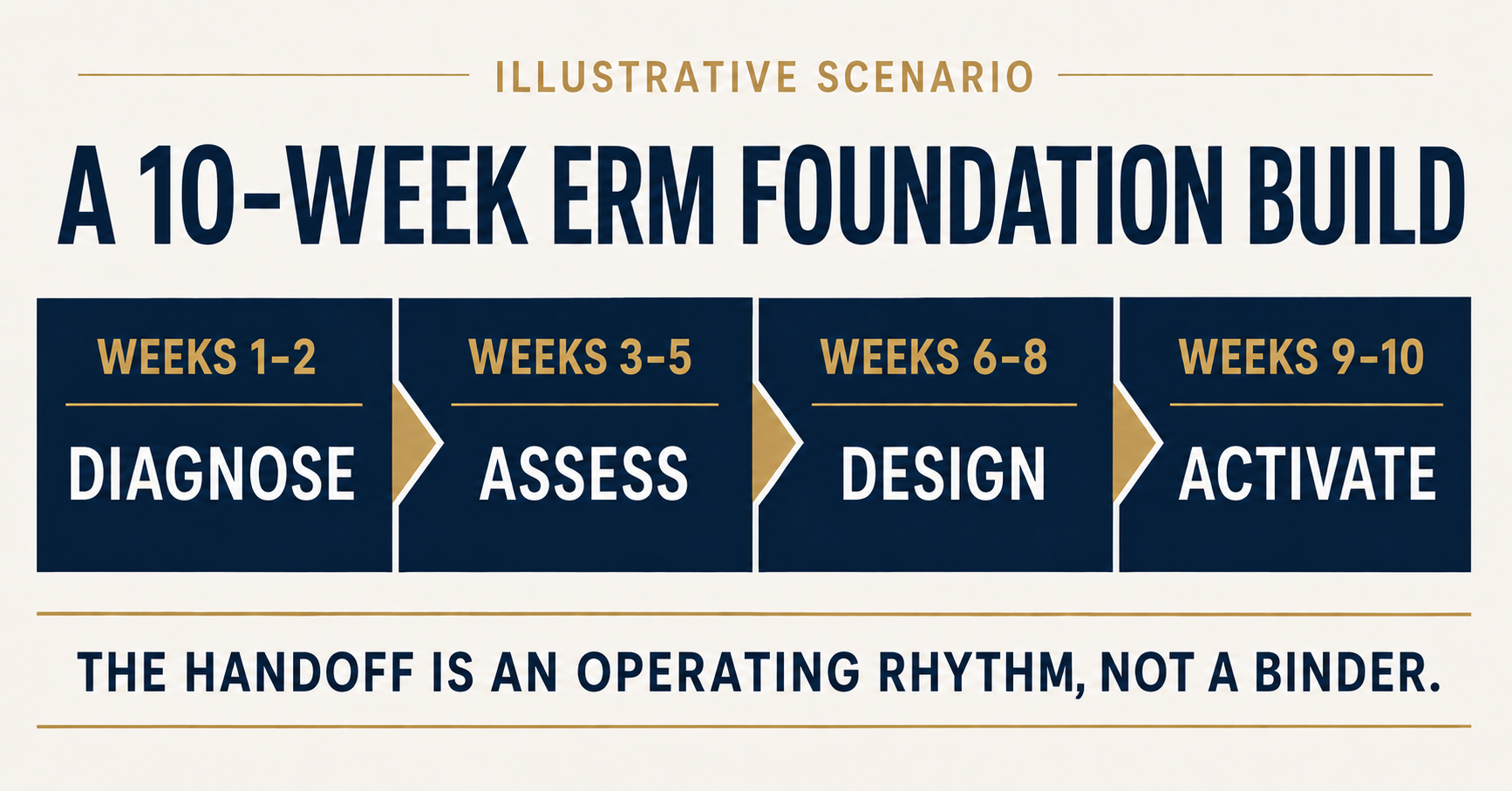
- Weeks 1 to 2: Diagnose current governance, interview leaders, review existing risk and audit materials, and agree scope and decision rights.
- Weeks 3 to 5: Identify and assess enterprise risks through leadership input and structured workshops.
- Weeks 6 to 8: Define ownership, risk appetite and tolerance, reporting cadence, and board-ready outputs.
- Weeks 9 to 10: Test the reporting cycle, train internal owners, resolve gaps, and hand off the operating rhythm.
Expected deliverables would include a prioritized risk register, a named owner for each risk, a governance and reporting cadence the company can run itself, and a leadership-ready report.
The honest counterpoint: timing extends toward 12 weeks when leadership availability is thin, when ownership of a risk is disputed and has to be settled before the register is useful, or when approval cycles slow decisions between phases.
Knowledge transfer is what determines whether the program survives the engagement. If the cadence only runs while an outside adviser is in the room, it is not a program yet.
Key Takeaways
Selecting the right partner from the landscape of business consulting firms offering enterprise risk management services doesn't have to feel overwhelming, provided you approach it as a structured decision rather than a reactive one.
Here's a concise summary of what mid-market CFOs, audit leaders, and finance executives should carry forward:
- Define your risk appetite first. No consulting engagement delivers value without internal clarity on what risks your organization is willing to accept.
- Match scope to firm size. Boutique specialists like Kennedy Risk Group provide deeper engagement for mid-market organizations, while larger firms suit complex, multi-jurisdictional needs.
- Evaluate credentials and frameworks. Look for alignment with established standards like COSO ERM and ISO 31000.
- Budget for cultural fit. A technically sound firm that can't integrate with your team creates friction that undermines results.
- Treat limitations honestly. Even strong engagements face resource constraints and implementation gaps.
The right ERM consulting partner doesn't just identify what could go wrong. They help build the organizational muscle to respond intelligently when it does.
Where to Start
If you're a mid-market CFO or audit leader evaluating ERM consulting partners, the most useful first step often isn't a discovery call with a firm. It's a clear-eyed assessment of where your current program actually stands.
The KRG Board-Ready Risk Reporting Scorecard gives you a tier-level assessment of where your current risk reporting program stands. Seven questions, no email required to see your score.
Take the Board-Reporting Scorecard
If you already know you need outside help, the ERM Program Diagnostic is a 1 to 2 week engagement designed specifically for mid-market organizations preparing to formalize or rebuild their ERM program.
Frequently Asked Questions
What's the difference between enterprise risk management consulting and general business advisory services?
Enterprise risk management consulting focuses specifically on identifying, assessing, and mitigating risks across the entire organization, connecting risk appetite to strategy, operations, and compliance. General business advisory services are broader and don't necessarily provide the structured frameworks, governance integration, or regulatory expertise that dedicated ERM consulting firms deliver.
How long does a typical ERM consulting engagement take?
For mid-market organizations, a focused risk assessment runs 4 to 6 weeks, a full ERM framework build runs 8 to 12 weeks, and an ongoing executive risk reporting cadence rolls out across 3 to 6 weeks. Fortune 500 program builds can span six to eighteen months, but that timeline reflects governance complexity, not methodology requirements. Mid-market companies don't need the long timelines.
When should a mid-market company consider hiring an ERM consultant?
Common triggers include rapid growth, regulatory changes, M&A activity, audit findings, or board-level pressure to formalize risk oversight. If risk discussions remain siloed by department, external expertise can accelerate alignment.
How do we measure ROI on ERM consulting?
Track reductions in unplanned losses, faster audit cycles, improved compliance scores, and stronger board confidence. Effective ERM programs ultimately protect enterprise value, making return measurable through both risk-avoided costs and strategic opportunities pursued with greater confidence.
What does an ERM consultant actually do?
An ERM consultant helps leadership identify and prioritize the risks that could derail strategy or earnings, then builds the process to manage them. The practical work usually includes a structured risk assessment, board-level reporting on a set cadence, and clear ownership for each major risk. Ownership is the part that matters most. It turns a static risk list into a program that changes real decisions. A good consultant also right-sizes the program. Mid-market companies do not need a Fortune 500 apparatus. They need a focused process a lean team can actually run.
What is the difference between ERM and financial risk management?
Financial risk management is a subset of ERM. It focuses on market, credit, liquidity, and currency exposure, and it usually sits with treasury or finance. Enterprise risk management is broader. It covers every category that could affect the business, including strategic, operational, compliance, technology, and reputational risk, not just the financial ones. ERM is owned at the executive and board level and ties directly to strategy. The simplest way to frame it: financial risk management protects the balance sheet, while ERM protects the whole strategy.
How much does ERM consulting cost for a mid-market company?
For companies in the $50M to $750M range, a program diagnostic typically runs $4,500 to $6,500 over one to two weeks, an executive risk reporting build runs $18,000 to $25,000, a targeted risk assessment runs $22,000 to $27,000, and a full ERM program build runs $52,000 to $70,000 over 8 to 12 weeks. Published ERM consulting cost figures are usually large-enterprise numbers and often bundle GRC software licensing, which is a separate cost from advisory work.