Risk Strategy
The Outsourced Chief Risk Officer: When a Fractional Risk Leader Makes Sense
Large companies solved risk leadership by hiring it. The mid-market usually can't justify the seat. Here is what an outsourced CRO actually does, what it costs, and how to tell whether it's the right model for your company.
By Eric Kennedy · Thu Jul 09 2026 · 7 min read

TL;DR: An outsourced chief risk officer, often called a fractional CRO, is an experienced risk executive who leads a company's risk program on a part-time, ongoing basis instead of as a full-time hire. The company gets senior risk leadership, a working risk program, and board-ready reporting for a fraction of the cost of an executive salary. The model exists because of a structural gap: most large companies have a designated risk leader and a complete ERM process, while most mid-market companies have neither, not because the risks are smaller but because the full-time seat is hard to justify. This piece covers what a fractional CRO actually does month to month, when the model fits, when it doesn't, and what it should cost.
Every mid-market CFO eventually has the risk leadership conversation. The board asks who owns risk. The honest answer is "sort of everyone," which everyone in the room understands to mean no one. Someone suggests hiring a chief risk officer. Then the math starts: a full-time risk executive is a multiple-six-figure commitment before bonus and benefits, for a role the company isn't sure it can keep busy. The conversation ends where it started, and risk stays a side duty attached to whoever objected least.
That pattern is the mid-market risk paradox.
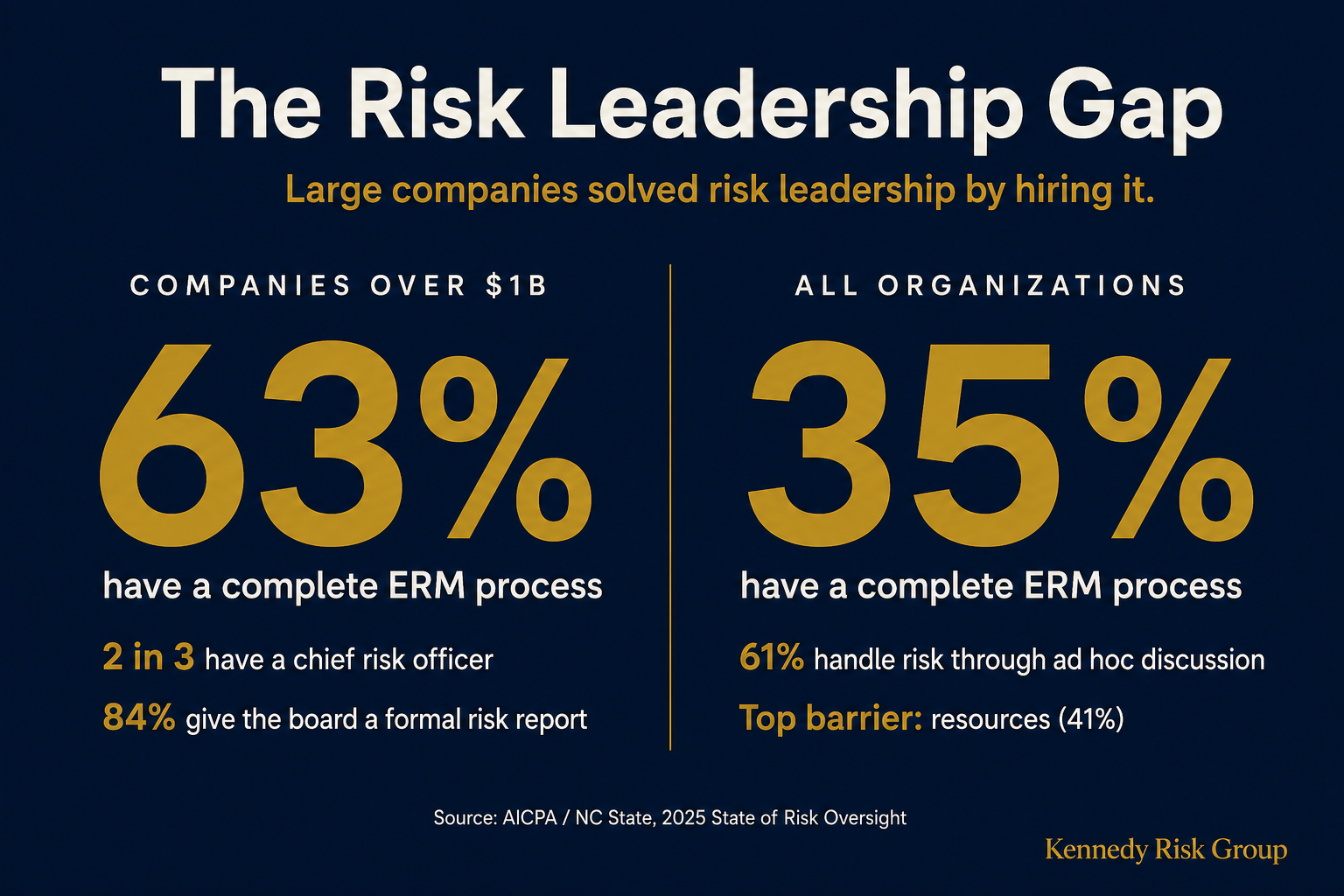
The data says this is the normal condition, not the exception. In the AICPA and NC State's 2025 State of Risk Oversight report, just under two-thirds of large organizations and publicly traded companies have appointed a chief risk officer or equivalent, and 63 percent of companies over $1 billion in revenue have a complete ERM process in place. Across the full sample, that figure drops to 35 percent. The gap is not conviction. When the same study asked what holds risk management back, the top two barriers, tied at 41 percent each, were competing priorities and insufficient resources.
In other words: large companies solved risk leadership by hiring it. Everyone else is still trying to solve it as a part-time assignment. The day to day shows what that looks like in practice: 61 percent of organizations say key risks reach senior executives through ad hoc discussions at management meetings, not through any scheduled risk conversation. The outsourced CRO model exists for exactly that gap.
What an outsourced CRO actually is
An outsourced chief risk officer, also called a fractional CRO, is a senior risk practitioner who runs your risk program as an ongoing engagement rather than as an employee. The commitment is typically a set cadence per month, the tenure is open-ended, and the scope is the same as an in-house CRO's: own the risk assessment, keep the register alive, make sure every material risk has an owner and a signal being watched, and put a credible risk report in front of the executive team and board on a schedule.
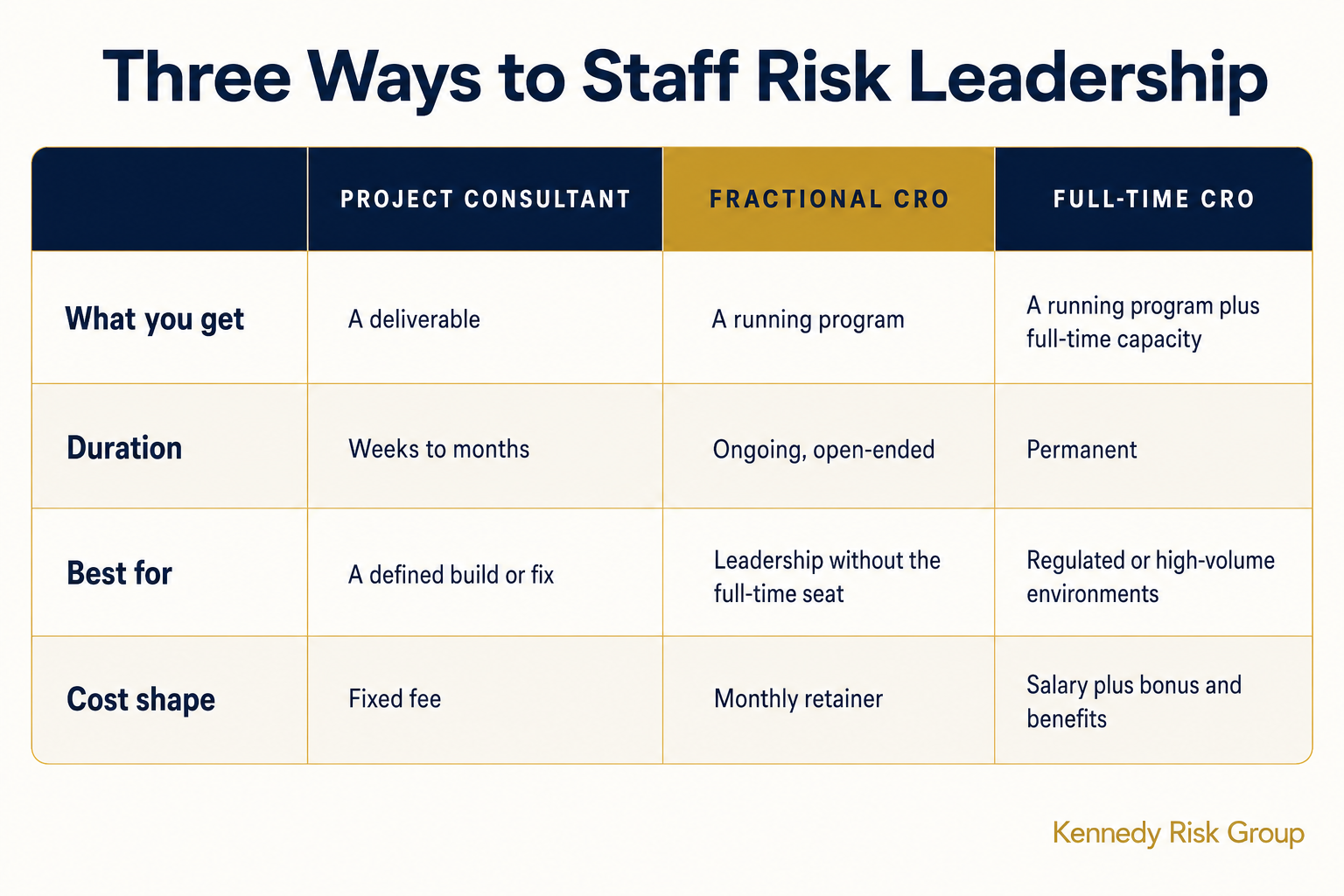
Two boundaries make the definition sharp. A fractional CRO is not a project consultant. A consulting engagement builds something and ends; a fractional CRO runs something and stays. And a fractional CRO is not a staffing arrangement where a junior analyst does risk paperwork under your roof. The entire point of the model is senior judgment: someone who has sat in the room when a board pushed back on a risk report and knows what happens next.
If you're weighing the bigger question of whether to build the function internally at all, that decision has its own tradeoffs, and I've written about in-house versus outsourced risk management separately. This piece assumes the narrower, more common mid-market question: you need risk leadership, a full-time hire is hard to justify, and you want to know whether the fractional model actually works.
What the work looks like month to month
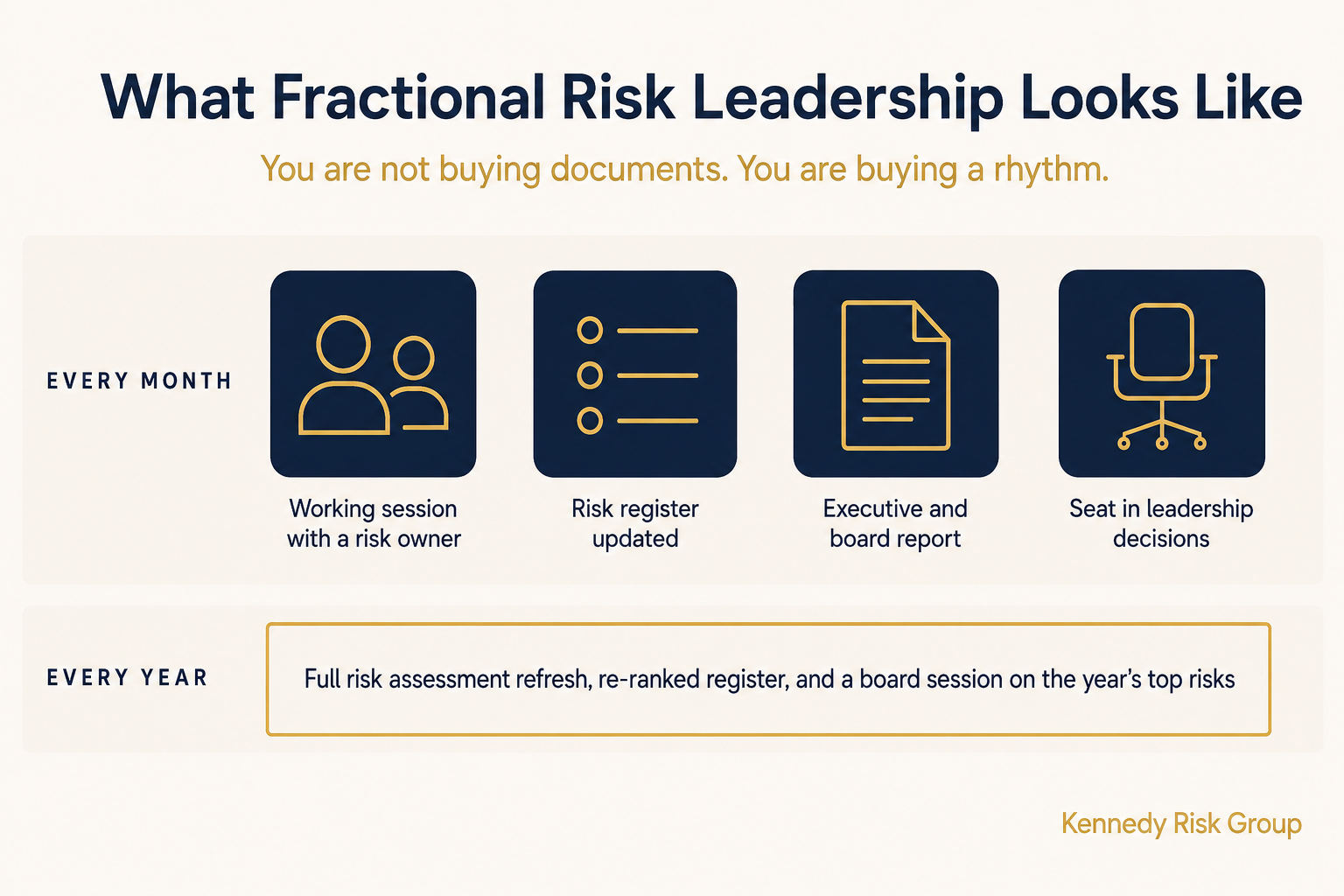
The deliverable of a fractional CRO is not a document. It is a running program. A representative month looks like this.
One working session with the executive team or a risk owner, on a rotation, pressure-testing a top risk: is the signal we chose still the right one, has the exposure moved, is the response actually funded and happening. One pass through the risk register, not to re-score everything but to update what changed and retire what resolved. One report produced, monthly or quarterly depending on your board cadence, short enough that leadership reads it and structured enough that it would hold up if a lender, investor, or acquirer asked to see it. And the connective work in between: sitting in on the leadership meeting where a decision with real risk implications gets made, catching the new customer concentration forming in the pipeline, flagging the integration that is quietly slipping.
Then, on an annual rhythm, the deeper cycle: a full risk assessment refresh with interviews across the leadership team, a re-ranked register, and a board session on the risks that matter for the coming year.
The pattern to notice is that almost none of this is producing artifacts. It is operating a system: owners, signals, cadence, reporting. That is why the model is fractional rather than project-based. The value is in the repetition.
When the model fits, and when it doesn't
The honest version of this section matters more than the sales version, so here is both sides as I see them after sixteen years of watching risk programs work and fail.
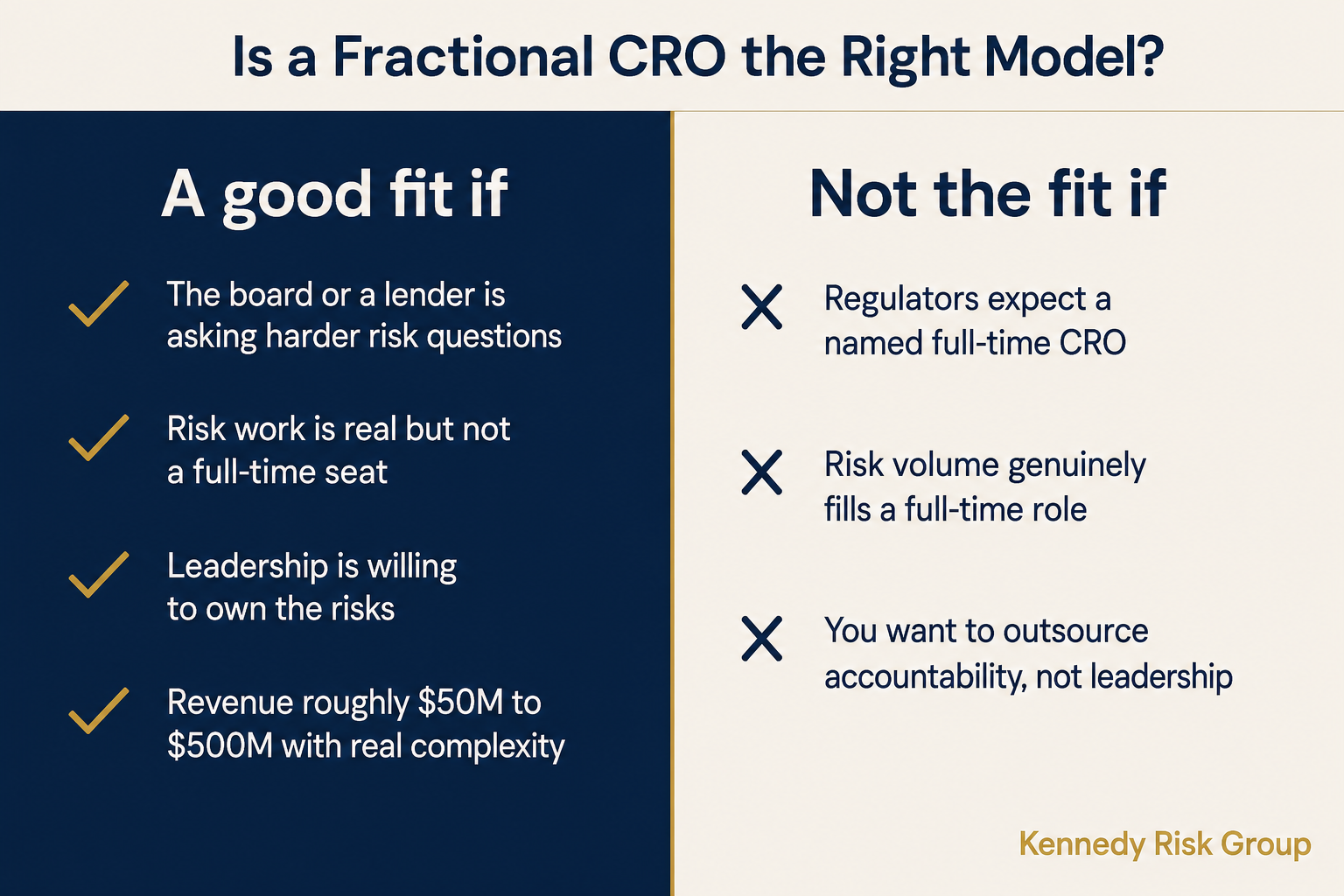
The model fits when: the company is roughly $50 million to $750 million in revenue, complex enough that risk lives in more than one function; the board, a lender, a sponsor, or an approaching transaction is asking harder risk questions than the current setup can answer; there is real work for a risk leader but not forty hours a week of it; and, most importantly, management is willing to own the risks. A fractional CRO runs the program. The risks themselves must belong to your operators, or the whole exercise becomes theater.
The model does not fit when: the company is regulated to the point that examiners expect a named, full-time risk executive on the org chart, which is common in banking and insurance; risk volume genuinely fills a full-time seat, which usually shows up as the fractional engagement bursting at the seams for two consecutive quarters; or leadership wants to outsource accountability rather than leadership. That last one is the quiet failure mode. If the executive team's mental model is "we hired someone so risk is handled," the model will fail slowly and then suddenly, no matter who you hire.
There is also a maturity signal worth naming. Companies often use fractional leadership as a bridge: the fractional CRO stands the program up, runs it for two or three years, and the company eventually promotes or hires a full-time owner into a program that already works. That is a success, not a churn problem. The wrong outcome is not graduating to a full-time hire; it is paying for leadership and getting paperwork.
What it should cost
Full-time first, for the anchor. A chief risk officer is a senior executive hire: a multiple-six-figure salary before bonus, equity, and benefits, plus the recruiting cycle to find one and the risk of a mis-hire in a role your company has never run before.
Fractional risk leadership in the mid-market typically runs between $4,500 and $10,000 per month depending on cadence and scope: the lower end for a light rhythm built around a quarterly board cycle, the upper end for a high-touch cadence with monthly reporting and a standing seat in leadership meetings. Annualized, even the high end is a fraction of the fully loaded cost of the equivalent full-time executive, and the engagement can flex up or down as the company's risk profile changes.
The comparison worth making is not fractional versus full-time, though. For most mid-market companies the real alternative is fractional versus nothing, because nothing is what the full-time math produces. Against that baseline, the question is simpler: what does an unowned risk cost when it lands? The 2025 data already showed how most companies answer, with 41 percent naming resources as the barrier. The fractional model is what makes the resource math stop being the reason.
How to choose one
Choosing a fractional CRO is choosing a person, not a firm, so the evaluation is closer to an executive hire than a vendor selection. The questions that matter: what have they run themselves, not advised on; what does their reporting actually look like (ask to see a sanitized example); how do they handle the handoff if you eventually hire full-time; and what would they do in month one. Vague answers to any of these are disqualifying. I keep a longer list of red flags when selecting a risk consulting partner in the ERM consulting buyer's guide, and every one of them applies double here, because a fractional leader is inside your leadership conversations, not just your document repository.
The other thing to look for is a low-risk way to start. A credible fractional CRO should not ask you to sign a year-long retainer on faith. The natural first step is a short diagnostic: a fixed-fee review of where your risk ownership, cadence, and reporting actually stand, which doubles as a working audition. You see how they think, they see what your program needs, and the retainer that follows is scoped on evidence instead of a pitch.
Where to Start
If the risk leadership conversation is live at your company, the fastest way to make it concrete is to talk it through against your actual situation: board cadence, current setup, what the sponsor or lender is asking for. If you'd rather begin with evidence, the ERM diagnostic is the fixed-fee starting point: a short review of where ownership, cadence, and reporting stand today, with the findings credited toward any ongoing engagement.
Start the conversation Explore the ERM Diagnostic
Frequently Asked Questions
What is an outsourced chief risk officer?
An outsourced chief risk officer, also called a fractional CRO, is an experienced risk executive who leads a company's enterprise risk management program on a part-time, ongoing basis rather than as a full-time employee. They run the risk assessment, maintain the risk register, ensure every material risk has a named owner, and deliver risk reporting to the executive team and board on a regular cadence.
What is the difference between an outsourced CRO and a fractional CRO?
In practice they are the same model under different names: a senior risk leader engaged on an ongoing, part-time basis. "Fractional" emphasizes the time commitment (a fraction of a full-time role), while "outsourced" emphasizes that the person is external rather than on payroll. Both differ from project consulting, which builds a deliverable and ends, because a fractional or outsourced CRO operates the program continuously.
How much does a fractional CRO cost?
Fractional risk leadership in the mid-market typically costs between $4,500 and $10,000 per month, depending on the cadence and scope of the engagement. A light engagement built around a quarterly board cycle sits at the lower end, while a high-touch engagement with monthly reporting and a standing role in leadership meetings sits at the higher end. Even at the top of that range, the annual cost is a fraction of a full-time chief risk officer's fully loaded compensation.
Does a mid-market company need a full-time chief risk officer?
Usually not. Outside heavily regulated industries like banking and insurance, most mid-market companies do not have enough dedicated risk leadership work to fill a full-time executive seat, which is why so few appoint one. What they do need is the function: a maintained risk register, named risk owners, and board-ready reporting on a cadence. A fractional CRO provides that function, and many companies later graduate to a full-time hire once the program has proven its value.
How is a fractional CRO different from hiring a risk consulting firm?
A consulting engagement is a project: it builds or fixes something specific, delivers it, and ends. A fractional CRO is an ongoing operating role: the same senior person runs your risk program month after month, sits in leadership conversations, and owns the reporting rhythm. Many companies use both in sequence, starting with a diagnostic or build project and transitioning to fractional leadership to run what was built.