Risk Strategy
Operational Risk Management for Mid-Market Manufacturers
The risks most likely to stop the line are operational. What actually threatens a mid-market manufacturer, and how to manage it without building a department.
By Eric Kennedy · Tue Jun 23 2026 · 8 min read

TL;DR: Operational risk for a manufacturer is the risk that something in the day-to-day running of the business stops the line, from equipment failure and supply chain disruption to quality escapes, safety events, and cyber attacks on plant systems. For mid-market manufacturers, these risks are larger than the financial or strategic risks that usually get the attention, and they are rarely managed by a formal program. Manufacturing has been the most attacked industry for cyber for five straight years, unplanned downtime costs have climbed faster than inflation, and roughly 80% of organizations had a supply chain disruption in the past year. Yet most mid-market plants have no named owner for operational risk and no structured way to surface it. This guide covers what actually threatens a mid-market manufacturer, why these companies are especially exposed, and how to build operational risk management that protects the line without hiring a full department.
A mid-market manufacturer rarely gets taken down by the risk at the top of the register. It gets taken down by the thing everyone on the floor knew about and no one escalated. The supplier that had been slipping for two quarters. The aging press that kept tripping. The quality drift that looked like noise until it became a recall. None of these are exotic. They are operational risks, and in manufacturing they are the risks most likely to cost real money.
For companies between $50M and $750M in revenue, operational risk is usually the largest category of exposure and the least formally managed. The financial controls are mature, the strategy gets board attention, and the thing that actually stops production is handled by whoever happens to notice. This guide is about closing that gap.
Disruption of this kind is where business continuity planning intersects with finance and audit.
Why operational risk in manufacturing is different
In most industries, operational risk is mostly about process and people. In manufacturing it is also physical, capital-intensive, and deeply dependent on a chain of outside parties. A single piece of equipment can halt an entire line. A single supplier can starve it. The cost of being wrong shows up immediately, in units not made and orders not shipped.
It is also one of the most exposed industries to cyber risk, which surprises a lot of manufacturing leaders who think of themselves as low-profile. Manufacturing has been the single most targeted industry in the world for five consecutive years, drawing 27.7% of all cyber incidents in the latest IBM X-Force analysis. The reasons are structural: aging operational technology that was never built to be online, valuable intellectual property, and a tolerance for downtime so low that attackers know a plant will often pay just to get the line moving again.
That combination, physical assets plus thin margins plus outside dependencies plus a growing attack surface, is why operational risk deserves more deliberate attention in manufacturing than almost anywhere else.
The risks that actually threaten a mid-market manufacturer
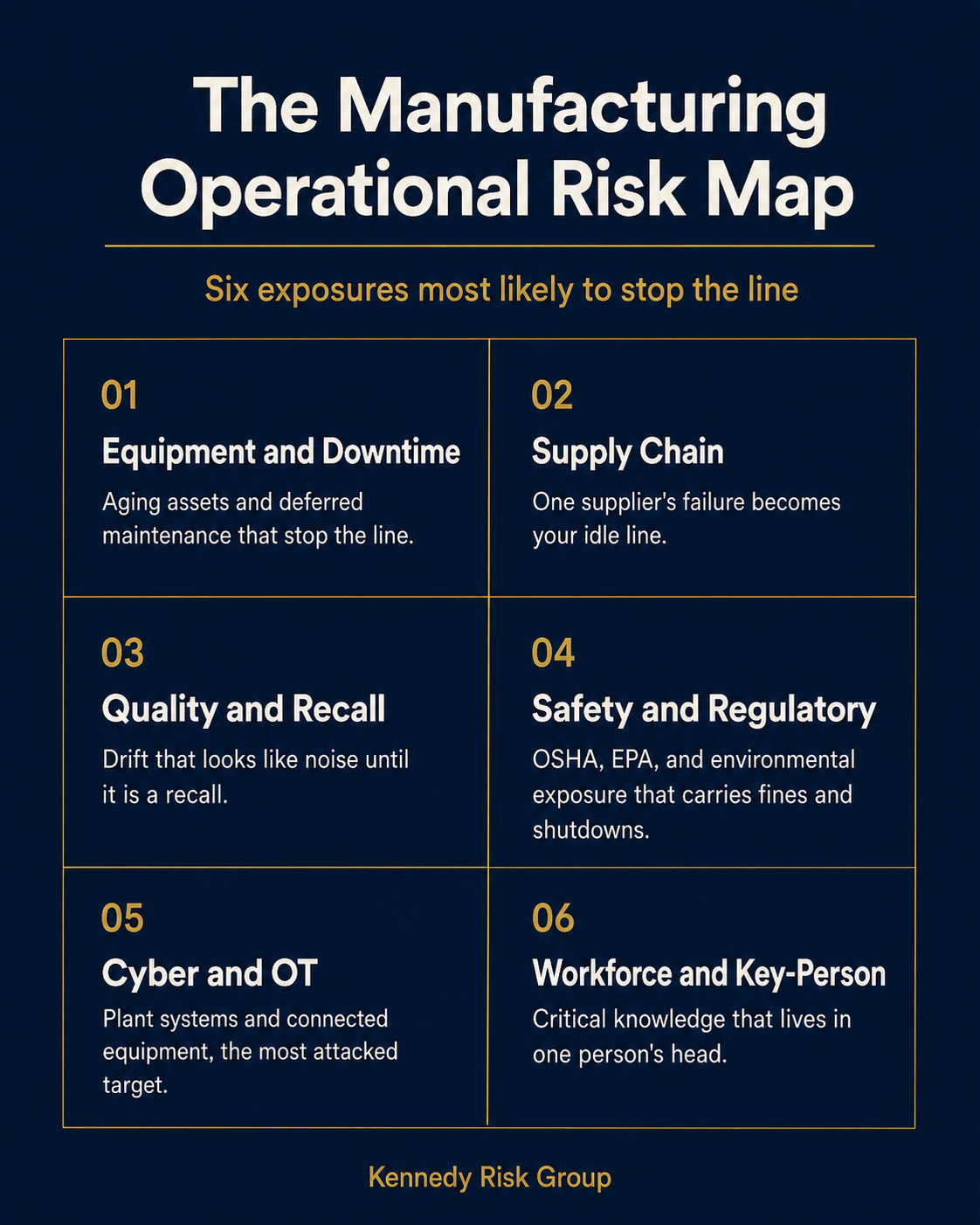
Six categories cover most of what goes wrong.
Equipment and downtime. Unplanned downtime is the cost most plants underestimate. Siemens found that the world's largest companies now lose roughly 11% of revenue to it, about $1.4 trillion a year, up sharply from five years earlier. A mid-market plant will never see those numbers, but it has far less financial slack to absorb a stoppage, and many manufacturers cannot say what a single hour of downtime actually costs them. Aging assets and deferred maintenance are the usual root cause.
Supply chain. Disruption is now closer to a constant than an event. The Business Continuity Institute found that almost 80% of organizations had their supply chains disrupted in the past year, with third-party failure the leading cause. For a manufacturer running lean and just-in-time, one supplier's problem becomes your idle line within days.
Quality and recall. A quality escape is the risk that compounds quietly. It starts as a small drift in a process, hides inside normal variation, and surfaces as scrap, a customer chargeback, or a recall that costs far more than the defect ever did. The expensive part is rarely the fix. It is the reputation and the lost contract.
Safety and regulatory. OSHA citations, environmental exposure, and EPA compliance are not paperwork risks. A serious safety event can stop production, trigger fines, and put a plant on a regulator's radar for years. For mid-market manufacturers without a dedicated compliance function, this is often the least-watched corner of the operation.
Cyber and operational technology. As above, manufacturing is the most attacked industry in the world. The exposure is not just the IT network. It is the OT environment, the programmable controllers and connected equipment that run the floor, where a breach does not just leak data, it stops machines.
Workforce and key-person. In a lot of mid-market plants, the most important risk control is one person who knows how everything actually works. When that knowledge lives in someone's head instead of in a process, their absence is an operational risk the same way a broken machine is.
Why mid-market manufacturers are especially exposed
Large manufacturers carry these same risks, but they also carry the staff to manage them: a risk function, a continuity team, a security operations group. Mid-market manufacturers carry the risk without the infrastructure.
Three things make the exposure worse at this size. The first is lean operations. Running just-in-time with little inventory buffer is efficient until something breaks, and then there is no slack to absorb it. The second is deferred capital. Equipment upgrades and maintenance get pushed during tight years, which quietly raises the odds of the failure that stops the line. The third is the absence of a named owner. Operational risk in a mid-market plant is usually everyone's job, which means it is no one's.
The data backs up the gap. The AICPA and NC State found that only about a third of organizations have a comprehensive risk process in place, and in the mid-market, where there often is no dedicated risk function at all, it tends to be lower. Most manufacturers in this range are managing operational risk informally, on the experience and instincts of a few people, which works right up until it does not.
What an operational risk program actually looks like
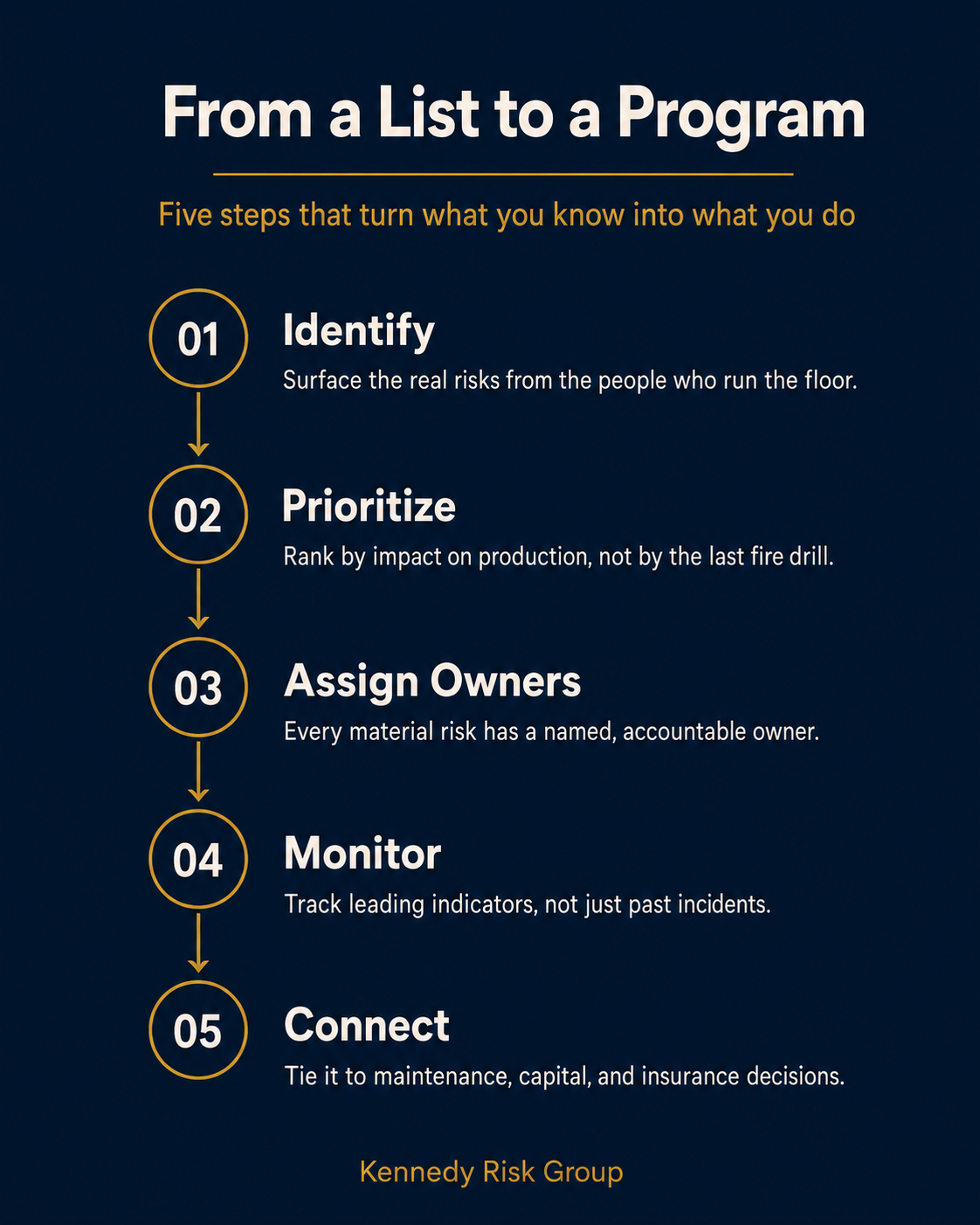
A program is not a binder, and it is not a spreadsheet that gets updated before the audit. A list of risks is not a program. A program is the operating system that turns what you know into what you do about it.
It starts with honest identification, which means asking the people on the floor what actually worries them, because they usually know where the next failure is coming from. It prioritizes by impact on production rather than by whatever caused the last fire drill. It assigns a named owner to every material risk, so accountability does not evaporate. It monitors leading indicators, the supplier that is slipping or the machine that is trending toward failure, instead of waiting for the incident. And it connects to the decisions that actually move risk: what gets maintained, what capital gets approved, and what gets insured.
None of this requires a department. It requires structure, a cadence, and someone accountable for keeping it running.
Your first moves
You do not have to build the whole thing at once. The highest-leverage first move for most mid-market manufacturers is a focused assessment: a clear-eyed read of where the real operational exposure sits, who owns it today, and what the few changes are that would matter most. That gives you a prioritized roadmap instead of a guess.
From there, the practical sequence is to name an owner, stand up a simple quarterly cadence to review the top risks, and start tracking a handful of leading indicators on the exposures most likely to stop your line. That is enough to move from informal to managed, and it is far less than most leaders assume.
The bottom line
For a mid-market manufacturer, operational risk is not a secondary concern behind the financials and the strategy. It is the category most likely to cost you a quarter. The risks are knowable, the failures are usually visible in advance, and the gap is almost never awareness. It is structure. Build the structure to surface what your team already knows and act on it, and you have managed the risk that actually threatens the line.
Where to Start
The fastest way to see where your operational exposure sits is to benchmark your current program. The KRG Board-Ready Risk Reporting Scorecard gives you a tier-level read in seven questions and about two minutes, with no email required to see your score. If you want a practitioner-level assessment of your specific gaps and the few changes that would matter most, the ERM Program Diagnostic is a one-to-two-week engagement built for mid-market organizations, and the diagnostic fee is credited toward a larger engagement if you move forward.
Take the ERM Scorecard Explore the ERM Diagnostic
Frequently Asked Questions
What is operational risk in manufacturing?
Operational risk in manufacturing is the risk that something in the day-to-day running of the business disrupts production. It covers equipment failure and unplanned downtime, supply chain and supplier failure, quality escapes and recalls, safety and regulatory events, cyber attacks on plant and operational technology systems, and key-person dependencies. It is distinct from financial risk, which concerns the numbers, and strategic risk, which concerns the direction of the business. In manufacturing, operational risk is usually the largest and most immediate of the three because it shows up directly as lost production.
What are the biggest operational risks for mid-market manufacturers?
The largest are equipment failure and unplanned downtime, supply chain disruption, quality and recall exposure, safety and regulatory events, cyber and operational technology attacks, and key-person dependencies. Cyber is more significant than many manufacturers expect, since manufacturing has been the most attacked industry for cyber for five straight years. Supply chain is now near-constant, with roughly 80% of organizations reporting a disruption in the past year. For a lean operation, any one of these can stop the line quickly.
Why is manufacturing the most targeted industry for cyber attacks?
Manufacturing has been the most attacked industry in the world for five consecutive years, accounting for 27.7% of cyber incidents in the most recent IBM X-Force analysis. The reasons are structural. Plants run aging operational technology that was never designed to be connected to the internet, they hold valuable intellectual property, and they have an extremely low tolerance for downtime, which makes them more likely to pay to restore production quickly. The attack surface includes not just IT systems but the programmable controllers and connected equipment that run the floor.
Does a mid-market manufacturer need a full risk department?
No. Most mid-market manufacturers cannot justify a dedicated risk function, and they do not need one to manage operational risk well. What they need is structure: a named owner for operational risk, a simple quarterly cadence to review the top exposures, a handful of leading indicators tracked on the risks most likely to stop production, and a link to the maintenance, capital, and insurance decisions that actually move risk. This can be built internally or with outside help, and it is far less work than standing up a department.
How do you start an operational risk program in a manufacturing company?
Start with a focused assessment that identifies where the real operational exposure sits, who owns each risk today, and the few changes that would matter most. That produces a prioritized roadmap rather than a guess. From there, name an owner for operational risk, stand up a quarterly review of the top risks, and begin tracking leading indicators on the exposures most likely to halt the line. Surfacing what the people on the floor already know, and assigning accountability for acting on it, is the core of the work.