Enterprise Risk Management
How to Write a Risk Contingency Plan: Triggers, Decisions and Recovery
A useful contingency plan pre-decides the trigger, activation authority, first actions, decision limits, communications and recovery condition, so the response does not wait for the next meeting.
By Eric Kennedy · Thu Nov 19 2026 · 9 min read

A supplier misses a delivery on Thursday afternoon. The next risk committee meets in five weeks. Before the normal approval chain can assemble, somebody has to decide which orders to protect, whether to pay for expediting, whether to switch suppliers and what to tell customers. A risk contingency plan exists for that gap between the event and the meeting.
A useful contingency plan pre-decides six things: the trigger that activates it, who has authority to activate it, the first actions, the resources and decision limits available, the communications, and the condition that means recovery is complete. It does not try to script every step. It settles the decisions that would otherwise wait for people who are not in the room.
Mitigation, contingency and continuity are different jobs
Mitigation acts before the trigger. It reduces the likelihood of the event or the exposure if it happens: a second qualified supplier, a safety stock policy, a control that stops a bad payment.
Contingency starts after an agreed trigger. Its job is to stabilize operations, make the decisions that cannot wait and recover.
A broader continuity plan sustains essential functions across a range of disruptions, such as losing a site, a system or key staff. A contingency plan for one register risk can sit inside it or alongside it.
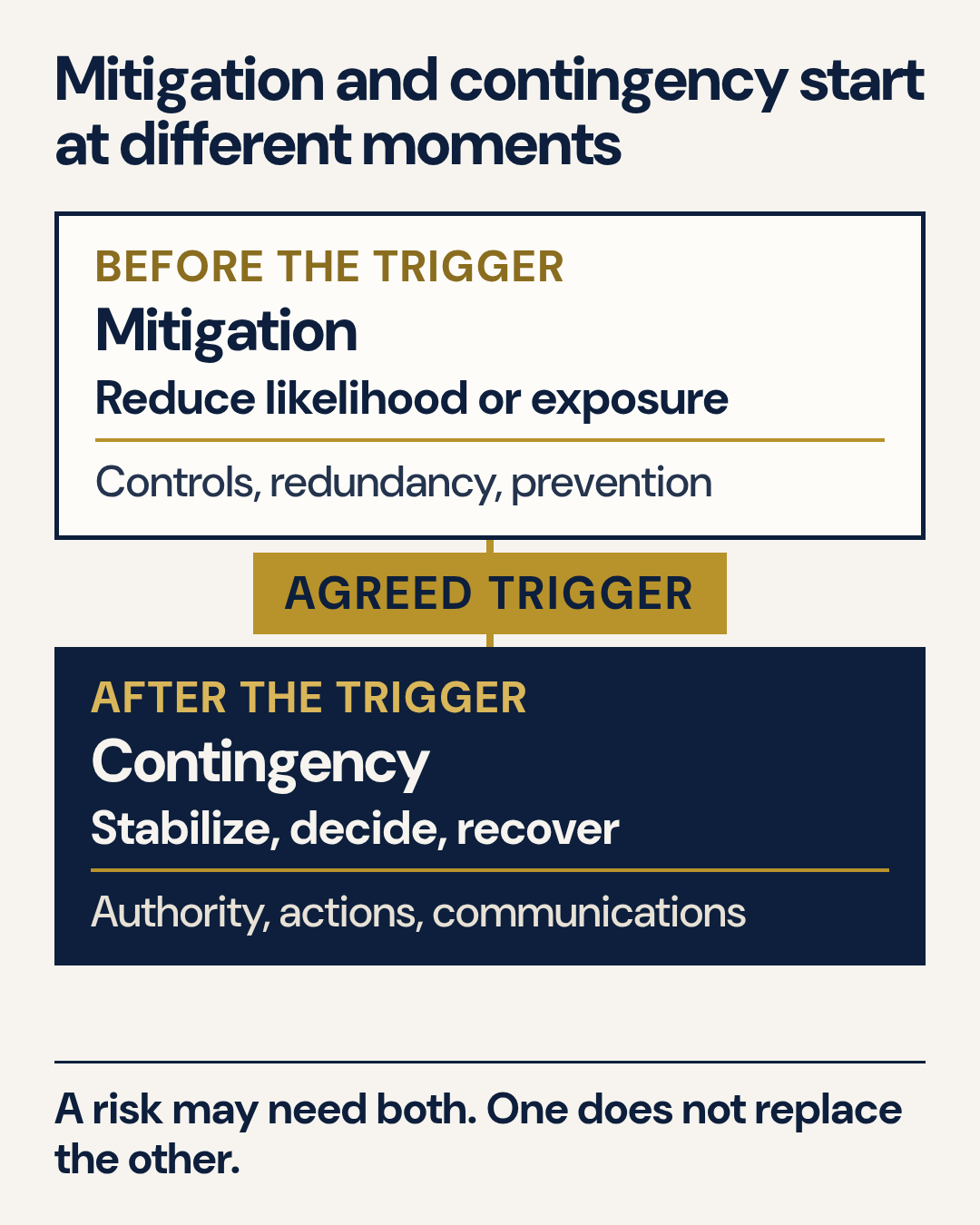
The graphic puts the agreed trigger between the two. Before the trigger, mitigation means controls, redundancy and prevention. After it, contingency means authority, actions and communications. A risk may need both, and one does not replace the other. Second-sourcing packaging is mitigation. Knowing who can approve expediting at 4 p.m. on a Thursday is contingency.
If the mitigation plan for the same risk is vague, fix that first. The guide to writing a risk mitigation plan covers actions, owners and evidence.
Which risks deserve a contingency plan
Not every register entry needs one. In my judgment, a risk earns a written contingency plan when at least one of these is true:
- The consequence outruns ordinary response. Normal management routines would not contain it in time.
- The decision window is shorter than normal governance. The choice has to be made in hours or days, and the committee that would normally make it meets monthly or quarterly.
- The fallback needs something reserved in advance. Authority, money, capacity, data or a third party has to be lined up before the event, because it cannot be arranged during it.
If none of these applies, the register entry and the mitigation plan are probably enough. Writing contingency plans for every risk produces a binder nobody reads.
Seven fields that make a contingency plan usable
These fields are a practical checklist, not an official standard.
- Event and assumption. What has happened, and what the plan assumes about it. For example, a supplier interruption that is expected to last days, not months.
- Observable activation trigger. A condition someone can check without debate: a missed confirmed delivery, a stock level, a system outage of stated length. "Significant disruption" is not a trigger.
- Activation authority and backup. One named role that can activate the plan, and a named backup when that person is unavailable.
- Actions by time horizon. What happens in the first hours, the first day and the first few days. Name the role responsible for each action.
- Resource and decision limits. What can be spent, committed or switched without returning to the normal approval chain, and who can approve it.
- Communications. Who must be told, by whom and when: customers, suppliers, lenders, the board or staff.
- Recovery condition, evidence and review owner. The observable condition that ends contingency operations, the records that show what happened, and the person who reviews the plan afterward.
The public guidance behind these fields comes from continuity and information-system planning. NIST SP 800-34 Rev. 1, the contingency planning guide for federal information systems (published May 2010, updated November 11, 2010), sets out a seven-step process that includes setting priorities through a business impact analysis, defining recovery strategies, testing, training and exercises, and keeping the plan maintained. It is written for US federal information systems, not as a private-sector requirement, but its planning disciplines transfer well.
FEMA's Continuity Guidance Circular (2018, 2024 update) says organizations should identify who has authority to activate a continuity plan and identify triggers to help leadership decide when to activate it. It describes mobilizing pre-identified personnel and resources, sustaining essential functions, and reconstitution, the phased return to normal or a new normal. It is flexible continuity guidance that private-sector entities can use, not a universal corporate requirement.
The UK government's Orange Book says in paragraph D9 that contingency, containment, crisis, incident and continuity arrangements should be developed and communicated, where appropriate, to support resilience and recovery if risks crystallise. In paragraph A5 it asks for clear processes, with agreed triggers, for bringing significant issues to the board more quickly. It is UK public-sector guidance, not a mandate for a US private company.
An illustrative packaging contingency plan
ILLUSTRATIVE SCENARIO. A mid-market manufacturer depends on one primary packaging supplier. The risk: a packaging interruption stops finished-goods shipments. The company is constructed, and every number, time and quantity below was chosen to show the structure. None is a prescription.
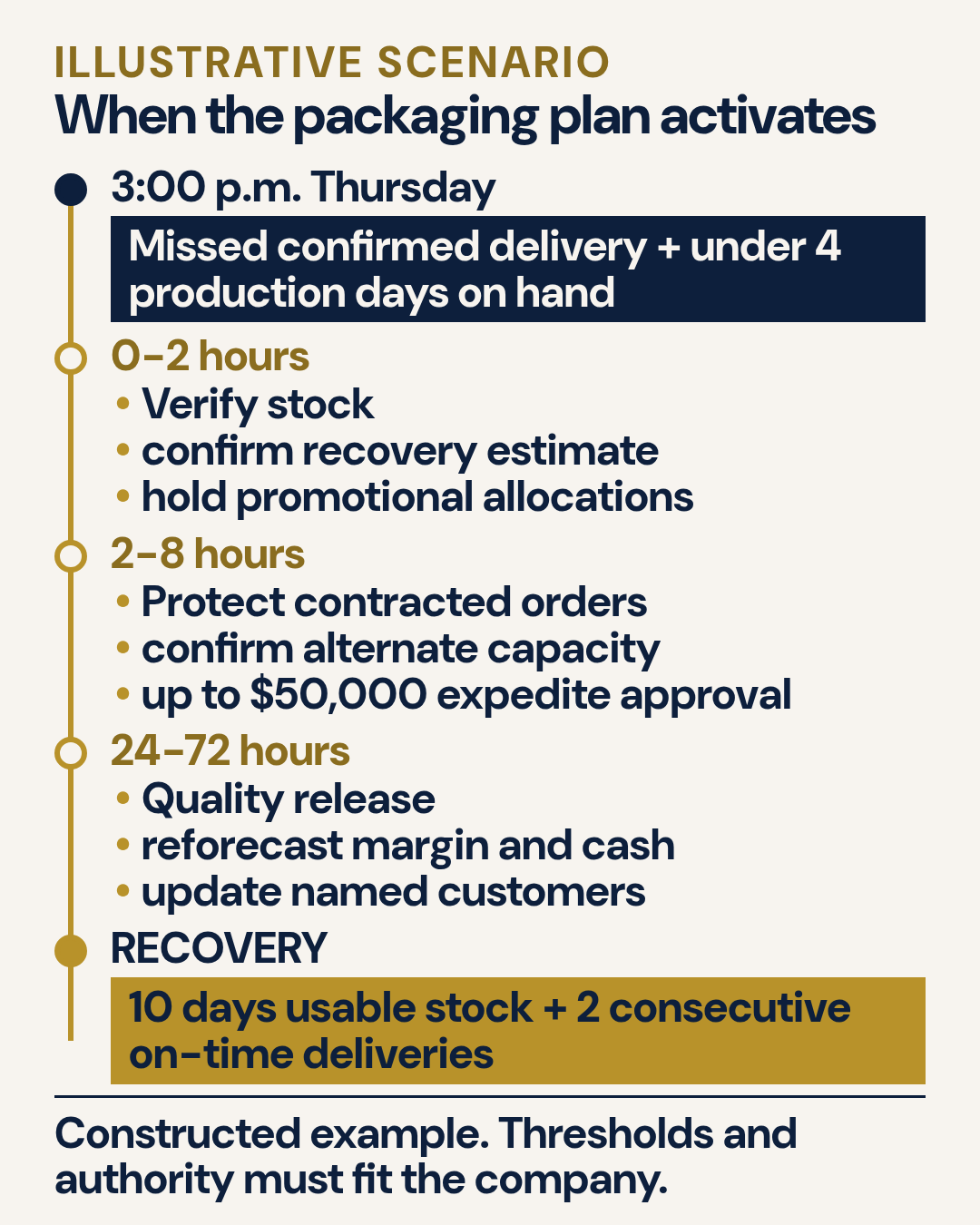
The plan activates at 3:00 p.m. Thursday when two conditions are both true: the primary supplier has missed a confirmed delivery, and usable packaging on hand is below four production days. The COO has activation authority, with the plant GM as backup.
In the first 0 to 2 hours, the team verifies usable stock by SKU, confirms the supplier's recovery estimate and holds new promotional allocations. From 2 to 8 hours, it reserves stock for contracted orders and confirms alternate-supplier capacity, and the CFO may approve up to $50,000 of expediting under delegated authority. From 24 to 72 hours, quality runs a release on the alternate packaging, finance reforecasts margin, cash and customer commitments, and account owners issue updates to named customers.
Recovery is reached when the company has ten days of usable packaging on hand and two consecutive on-time deliveries from an approved source. The footer of the graphic states the point plainly: this is a constructed example, and thresholds and authority must fit the company.
| Field | Illustrative packaging plan |
|---|---|
| Event and assumption | Packaging interruption stops finished-goods shipments; the primary supplier is assumed to recover within days |
| Activation trigger | By 3:00 p.m. Thursday, the primary supplier has missed a confirmed delivery and on-hand packaging is below four production days |
| Activation authority | COO, with plant GM as backup |
| 0 to 2 hours | Verify usable stock by SKU; confirm the supplier's recovery estimate; hold new promotional allocations |
| 2 to 8 hours | Reserve stock for contracted orders; confirm alternate-supplier capacity; CFO may approve up to $50,000 of expediting under delegated authority |
| 24 to 72 hours | Run quality release on alternate packaging; reforecast margin, cash and customer commitments; issue named customer updates |
| Recovery condition | Ten days of usable packaging on hand and two consecutive on-time deliveries from an approved source |
| Evidence | Inventory report, supplier confirmation, quality release, approval record, customer communication log |
Three details matter more than they look. The trigger has two conditions, so a single late truck with plenty of stock on hand does not activate the plan. The $50,000 limit exists so the CFO does not need to find a quorum before paying for a faster truck, and it sits inside authority the board has already delegated. The recovery condition is observable, which stops the plan from ending because the supplier said things were fine.
The evidence list does a second job. After the event, those five records let the review owner check whether the trigger fired when it should have, whether authority was used within its limit and whether customers heard from the company before they heard from their own receiving dock.
Too much detail makes the plan brittle
There is a real counterpoint here. A plan that scripts every step for one imagined version of the event breaks when the actual event is slightly different. The supplier's outage might be partial. The alternate supplier might have capacity but not the right board grade. A 40-page plan also tends to go stale faster than anyone updates it.
My view, shaped by running an enterprise risk program at a Fortune 50 technology company, is that the plans worth having settle the decisions people would otherwise wait on and leave the operating detail to the people doing the work. Pre-decide the trigger, the authority, the spending and commitment limits, and the non-negotiables, such as contracted customers first or no unapproved packaging shipped. Leave room for judgment on everything else.
Test the plan before the event does
A tabletop exercise is the cheapest way to find out whether the plan works. The test is not whether people can recite it. It is whether the authority is real, the contacts answer, the alternates exist, the data can be produced in the time assumed and the decision rules give a clear answer. The business continuity tabletop exercise guide covers how to design and run one.
The cadence should fit the risk. FEMA's 2018 non-federal continuity plan template included annual review, but that is a reference point rather than a universal minimum. Review sooner after a material change to the people named in it, the vendors, systems or sites it depends on, the decision limits or the dependencies it assumes. If the plant GM who is the backup authority leaves, the plan is out of date that day.
Triggers can also be connected to monitoring. Where a key risk indicator already tracks days of packaging cover or supplier on-time performance, the contingency trigger can be a defined level of that indicator, so the warning and the activation use the same number.
Where to start
Pick the two or three risks from your enterprise risk assessment where the decision window is shortest. For each, write down who could activate a response tonight and how much they could spend without calling anyone. If the honest answer is "nobody" or "not sure," that is the first contingency plan to write.
If you want a quick view of how well your current risk reporting would support those decisions, the scorecard is a short starting point.
Take the Risk Reporting Scorecard
Frequently Asked Questions
What is the difference between a risk mitigation plan and a contingency plan?
A mitigation plan acts before the trigger to reduce the likelihood of an event or the exposure if it happens. A contingency plan starts after an agreed trigger and sets out who can activate a response, the first actions, decision limits, communications and the condition for recovery. Many significant risks need both.
What should a risk contingency plan include?
At minimum: the event and its assumptions, an observable activation trigger, a named activation authority with a backup, actions by time horizon, resource and decision limits, communications, and a recovery condition with the evidence to keep and a named review owner.
What is a contingency trigger?
A condition that can be checked without debate and that activates the plan, such as a missed confirmed delivery combined with stock below a set number of production days. Vague phrases such as significant disruption are not triggers, because people will argue about whether they have been met.
How often should a contingency plan be tested and reviewed?
The cadence should fit the risk. FEMA's 2018 non-federal continuity template included annual review, but that is a reference point rather than a universal minimum. Review sooner after a material change to people, vendors, systems, sites, decision limits or dependencies, and use a tabletop exercise to test whether authority, contacts, alternates, data and decision rules work.