Enterprise Risk Management
How to Write a Risk Mitigation Plan: Actions, Owners and Evidence
A mitigation action can be finished on time while the risk stays where it was. How to specify the change, owner, date and evidence so the plan can be checked.
By Eric Kennedy · Tue Nov 17 2026 · 11 min read

"Update the procedure" can be completed without changing the risk. Someone saves a new version of a document, the action turns green, and the exposure stays where it was. Nothing in the entry says what will change in practice, who will make that happen, or how anyone would know the exposure is smaller.
A usable mitigation action specifies six things: the change, the accountable action owner, the resources and dependencies, the delivery date, the evidence that will show the change works, and the date the risk owner will review that evidence and decide, within delegated authority, whether to accept the remaining exposure or escalate it. The last two separate activity from risk reduction, and a plan that tracks only status has no place for them.
What a risk mitigation plan is for
A mitigation plan records how the organization intends to change a risk it has decided not to simply accept. The action owner should know what to deliver, the risk owner what they will be asked to judge, and a later reviewer whether it worked.
The UK government's Orange Book is a useful public reference. In its guidance on risk treatment and monitoring (paragraphs D7 to D11), it asks organizations to specify how a chosen treatment will be implemented, so that the people involved understand it and its effectiveness can be monitored. Its list includes the proposed actions, who is accountable, the resources required, control indicators and timing. It also says monitoring should happen before, during and after implementation, including whether internal controls are operating as intended.
The Orange Book is written for UK public bodies. It is not a legal requirement for a US company, and it does not show that any particular plan format reduces risk. It is useful here because it treats a mitigation plan as something to monitor, not just deliver.
A plan also needs a clear risk to work against. If the register entry is a two-word label, fix that first. The guide to writing risk statements shows how.
The six parts of a usable mitigation action
The method below is practical advice, not an official standard. It borrows the Orange Book's emphasis on monitoring and adds an explicit evidence and decision step.
- The change. What will be different in the process, system, contract or behavior once the action is done. Write it so someone could observe it. "Update the procedure" is a task. "Hold every supplier bank-detail change until AP calls back a number verified from independent records" is a change.
- The accountable action owner. One role responsible for delivery. This is often not the risk owner, and the difference matters; risk owner vs action owner explains why.
- Resources and dependencies. The budget, people time, system work or other teams the action relies on. If the action depends on a team that is already stretched, say so here. The article on mitigation and shared capacity covers what happens when several plans draw on the same people.
- The delivery date. A date, not a quarter or "ongoing". If the action has stages, give each stage its own date.
- The evidence that the change works. Agreed in advance: what will be examined, over what period, and what result would count as working. This is the acceptance criterion for the action.
- The risk owner's review. A date when the risk owner looks at the evidence and decides, within their delegated authority, whether to accept the remaining exposure or escalate it.
Writing the evidence criterion first forces agreement on what done means while the action can still be designed around it.
An illustrative worked plan
The example below is constructed. All roles, dates and periods are illustrative, and the dates fall in the same year.
ILLUSTRATIVE SCENARIO. Risk statement: because supplier bank-detail changes are accepted by email and processed without independent verification, a fraudulent change request in the next 12 months could redirect a supplier payment, causing a cash loss and a late payment to a supplier the business depends on.
The original plan entry read: "Update the AP procedure. Owner: Finance. Due: Q1."
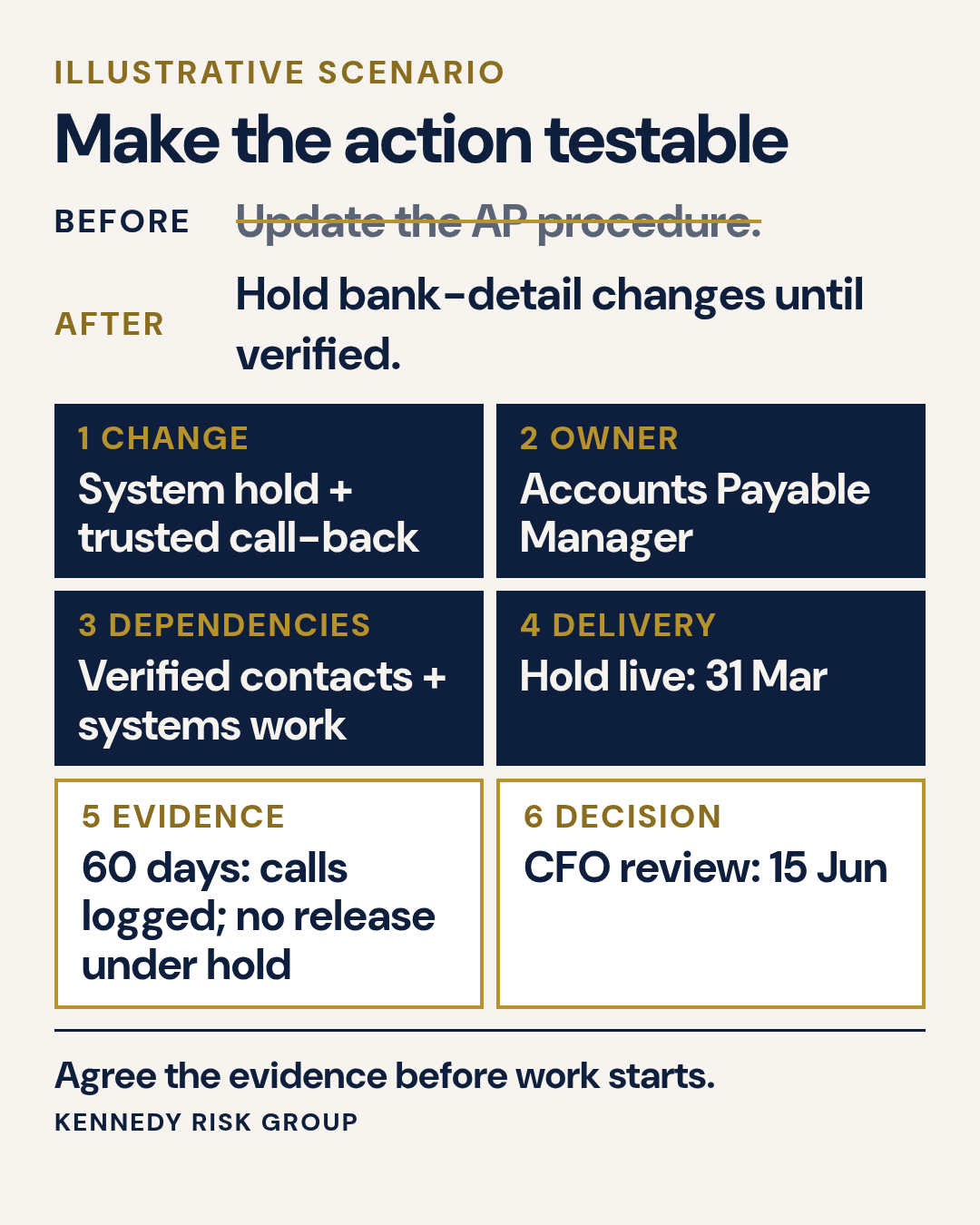
Reading the rewrite
The point of the rewrite is to make the action testable. "Update the AP procedure" becomes "Hold bank-detail changes until verified", and that sentence breaks into six parts. The change is a system hold plus a trusted call-back. The owner is the Accounts Payable Manager. The dependencies are verified contacts and systems work. Delivery means the hold is live on 31 March. The evidence is 60 days of logged calls and no release under hold, meaning no payment was released to changed bank details while a hold was open. The decision is the CFO's review on 15 June. The first four parts describe the work; the last two are where the risk owner learns something, which is why the evidence should be agreed before work starts. The table gives the full wording.
| Part | Weak entry | Testable version (illustrative) |
|---|---|---|
| The change | Update the AP procedure | Every supplier bank-detail change is held in the ERP until AP calls back a number verified from independent records; overrides need controlled authorization |
| Action owner | Finance | Accounts Payable Manager |
| Resources and dependencies | Not stated | Systems team configures the hold; call-back numbers verified from independent records first, not from the request |
| Delivery date | Q1 | Numbers verified 28 Feb; hold live 31 Mar |
| Evidence it works | Not stated | For 60 days after go-live, every change has a logged call-back, and no payment was released to changed bank details while a hold was open |
| Risk owner review | Not stated | CFO reviews the evidence by 15 Jun and, within delegated authority, accepts the remaining exposure or escalates it |
Two details are easy to miss. The call-back is only as good as the number it goes to. That number has to come from trusted records or a contact already verified independently, not from the email asking for the change, or the call can reach the fraudster. And the evidence criterion looks at the control in use, on real changes after go-live, rather than checking that a procedure document exists.
This control addresses one route for payment fraud. It is not complete fraud prevention, and the hold is only meaningful if overriding it requires controlled authorization. The evidence it produces supports a judgment about the control. It does not prove the risk is gone.
How much to examine is a design choice. With a small population, reviewing every change may be feasible. With a larger one, a sample may be more proportionate. Sample design depends on the risk, how often the control runs, the size of the population and how much assurance the risk owner needs; there is no universal count. Whatever the choice, record it before the results come in.
Completion, operating effectiveness and residual exposure
A plan that tracks only status will show this action as done on 31 March of the illustrative year. Three separate questions are actually in play:
- Was the action completed as specified?
- Is the resulting control operating as intended?
- Can the risk owner accept the remaining exposure within their delegated authority?
Each can have a different answer. The hold can be live and routinely overridden. The call-backs can happen every time while exposure stays above tolerance, because the same fraud can arrive through a different route, such as a forged invoice. One green status hides all three. The article on residual risk assessment covers how to compare current exposure with the target.
Insufficient evidence means not verified
Two situations look similar and are not. In this example the documented call-back is part of the specified control. If the log is missing, the documentation requirement has not been met, even if someone did make the call. The control did not operate as specified.
The other situation is a control that was never meant to leave a record, or one where the available evidence is too thin to judge. There, the honest status is "not verified", which is not the same as failed. Record what is needed and a date to collect it. Marking the action failed without evidence is as unsupported as marking it effective.
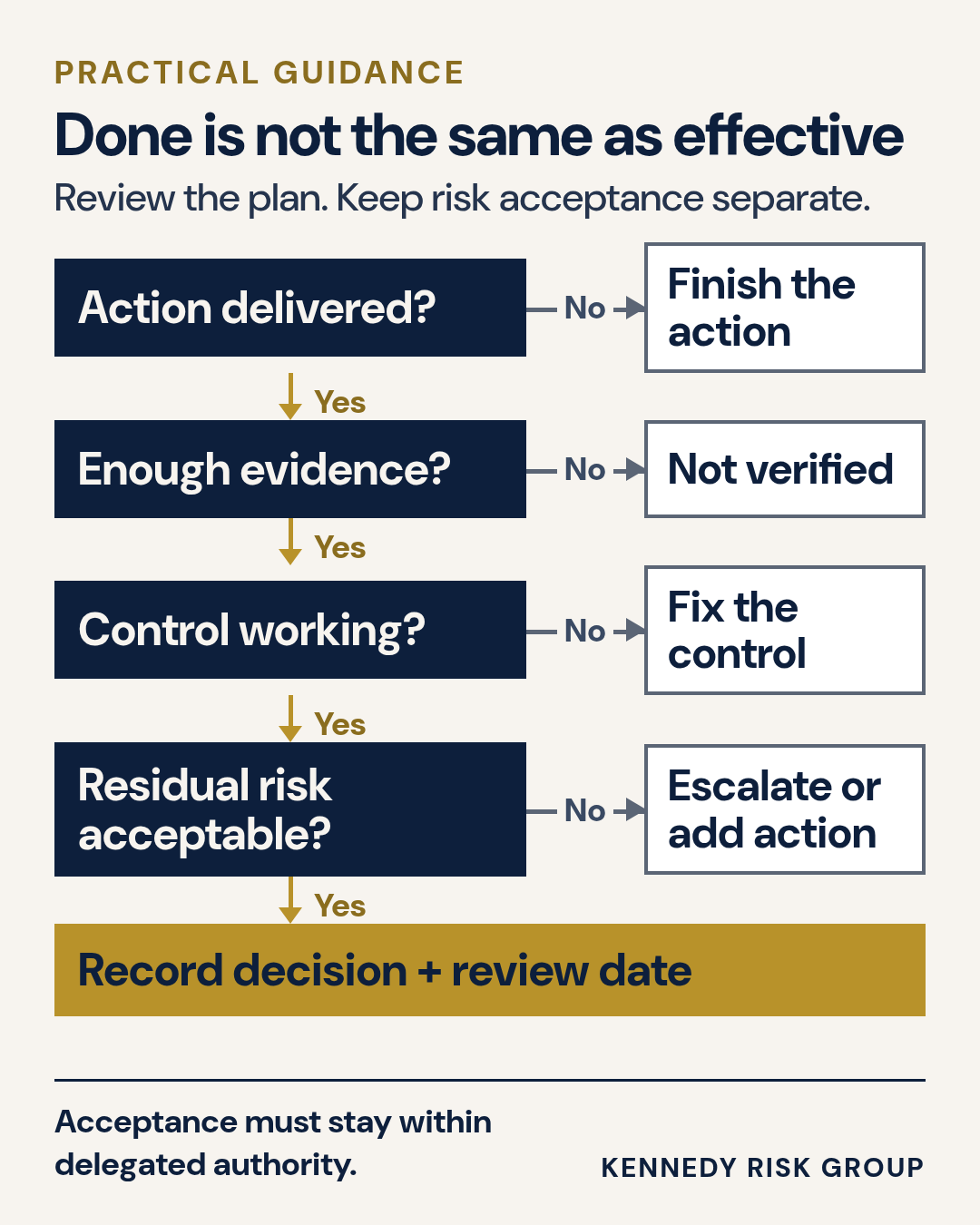
Reading the evidence path
Done is not the same as effective. The path is a proposed way to review a mitigation plan, not an official standard or an internal audit workflow, and it keeps risk acceptance separate from the action itself. It asks four questions in order:
- Action delivered? If not, finish the action. Get an explanation and a new date; a long delay can amount to accepting the risk.
- Enough evidence? If not, the action is not verified. Name the missing evidence and a date. Not verified is not the same as failed.
- Control working? If not, fix the control, or redesign the action.
- Residual risk acceptable? If not, escalate or add action, using the authorized acceptance process. If yes, record the decision and a review date.
The first three questions are about the action, and they can be answered and recorded on their own. An action that was delivered and shows the control working can be closed even while the risk is still being discussed. The fourth question belongs to the risk record. Acceptance must stay within delegated authority: exposure can fall outside a risk owner's authority without being numerically above a stated tolerance, for example when the board has reserved approval for that category of exposure, and then the owner should not accept it alone.
Who decides what
The action owner delivers the change. The risk owner decides whether to accept the remaining exposure, but only within the authority they have been delegated. Exposure beyond that goes to whoever is authorized to accept it, and the decision should be recorded with a date. When an action slips, someone is accepting the risk by default; what to do when mitigation is overdue covers how to make that decision explicit.
Internal audit has a defined but narrower role. The IIA's 2024 Global Internal Audit Standards, in Standard 15.2 (shown in the IIA's official mapping document), require internal auditors to confirm that management has implemented audit recommendations or management action plans. The method includes asking about progress, carrying out risk-based follow-up and updating status in a tracking system, with the extent of follow-up reflecting how significant the finding is. Where actions are late, the chief audit executive decides whether senior management, by delay or inaction, has accepted a risk beyond tolerance.
That standard applies to internal audit's follow-up of its own findings. It does not make internal audit the approver of every ERM mitigation action, and it does not move the acceptance decision away from management. Keeping that line clear protects audit's independence. One practical benefit still carries over: when a plan already states its evidence criteria, audit follow-up has something concrete to test.
Keep the evidence proportional
Not every action needs six fields and a 60-day review. Adding a second approver to a rarely used journal type might need only a configuration screenshot and one test entry. That evidence shows the setting was configured as intended on the day it was checked. It does not show the control kept operating afterwards, and for a low-risk action that may be enough.
A reasonable rule of thumb, offered as judgment rather than a standard: scale the evidence to the significance of the risk and to how quietly the control could fail. A control that depends on a person remembering a step usually needs more evidence of operation than a system setting that is harder to bypass, although system settings can still be changed or overridden.
A 30-minute test for your current plan
Pick five open mitigation actions and ask of each:
- Could someone observe the change, or is it a task like "update" or "review"?
- Is there one accountable action owner?
- Are resources and dependencies named?
- Is there a date rather than a quarter?
- Is the evidence criterion written down before the result is known?
- Is there a date for the risk owner's review and decision?
Any action that fails questions 5 or 6 can be completed without anyone learning whether the risk changed. Those are the ones to rewrite first.
If your plan reads more like a task list than a record of evidence, it is worth checking what leadership sees as well. The Risk Reporting Scorecard is a short self-assessment of seven questions that shows where your reporting is weakest.
Take the Risk Reporting Scorecard
Frequently Asked Questions
What should a risk mitigation plan include?
For each action: the change that will be made, one accountable action owner, the resources and dependencies it needs, a delivery date, the evidence that will show the change works, and a date when the risk owner will review that evidence and decide, within delegated authority, whether to accept the remaining exposure or escalate it.
How do you know if a risk mitigation action is effective?
Agree the evidence before the work starts: what will be examined, over what period and what result counts as working. Then check the control in use, not just that the action was completed. If the control requires a record, such as a call-back log, a missing record means that requirement was not met. If the evidence is simply too thin to judge, record the action as not verified rather than failed, and set a date to collect more.
Who decides when a risk mitigation action is closed?
Closing the action and accepting the remaining risk are separate records. An action can close once it is delivered and the evidence shows it operating. The risk owner can then accept the remaining exposure only within delegated authority; anything beyond that goes through the authorized acceptance process. For actions arising from its own findings, internal audit confirms implementation through risk-based follow-up, but it does not approve ERM mitigation actions in general or take over management's acceptance decision.