Risk Strategy
What ERM Consulting Costs (and What Actually Drives the Number)
ERM consulting is priced by scope, not a standard rate. Here is what drives the number, what the market charges, and how to budget.
By Eric Kennedy · Thu Jun 18 2026 · 8 min read

TL;DR: Enterprise risk management consulting is priced by scope, not by a standard rate, which is why there is no published price list for it. What you pay is driven by five things: the scope of the work, the size and complexity of your company, the engagement model, the type of firm you hire, and how much board-level involvement the work requires. At the top of the market, large strategy and Big Four firms post government rates that run past $1,000 an hour for senior partners. Independent and practitioner-led advisors typically run a fraction of that. The useful way to think about budget is not by rate, but by engagement type: a focused assessment, a full program build, or ongoing advisory support. This guide breaks down what drives the number and how to compare quotes so you are not paying a strategy-firm rate for staff-level work.
The first thing to know about the cost of ERM consulting is that anyone who answers the question with a single number is guessing. There is no standard rate for enterprise risk management consulting the way there is for an audit or a tax return. Two firms can quote the same company for what sounds like the same work and land thousands of dollars apart, because they are scoping different work, staffing it differently, and pricing it on different models.
That does not mean the question is unanswerable. It means you have to ask a better one. Not "what does ERM consulting cost," but "what drives the number, and what should a company my size budget for the outcome I actually need." This guide answers both.
The cost question sits downstream of the mid-market risk paradox.
Why ERM consulting has no sticker price
Most professional services that get commoditized share one trait: a defined, repeatable deliverable. A financial statement audit has a scope shaped by standards. ERM consulting does not. The work ranges from a two-week assessment that produces a maturity read and a roadmap, to a multi-month engagement that builds a full program from risk appetite through board reporting, to an ongoing relationship that runs the program quarter after quarter.
Those are not the same product at different prices. They are different products. Pricing them against a single benchmark is like asking what a contractor charges without saying whether you want a kitchen refresh or a new house. The honest answer is always a range, and the range only narrows once the scope is real.
This is also why the price you are quoted tells you very little on its own. A low number can mean an efficient, senior-led engagement, or it can mean a thin scope and a junior team. A high number can mean deep expertise and partner attention, or it can mean brand and overhead you are not getting value from. The number is an output. The drivers are what you should be reading.
What you are actually paying for
Almost every ERM engagement falls into one of three buckets, and knowing which one you need is the single biggest factor in what you will spend.
The first is a diagnostic or assessment: a focused, time-boxed engagement that evaluates how mature your risk program is, identifies the gaps, and gives you a prioritized roadmap. It is the smallest commitment and usually a fixed fee.
The second is a program build: the work of standing up or rebuilding the program itself, which can include the risk assessment, a board-approved risk appetite, the register, the reporting cadence, and named owners. This is the largest of the three, scoped in weeks to months.
The third is ongoing advisory, sometimes called a fractional model: an outside risk leader who runs the program and the board cadence on a continuing basis, priced as a monthly retainer rather than a project fee.
The reason this matters for budget is that people often shop for one and get quoted for another. A company that needs a quick assessment does not need to pay for a full build, and a company that needs continuity does not get it from a one-time project. Match the engagement type to the outcome before you compare any prices.
What actually drives the number
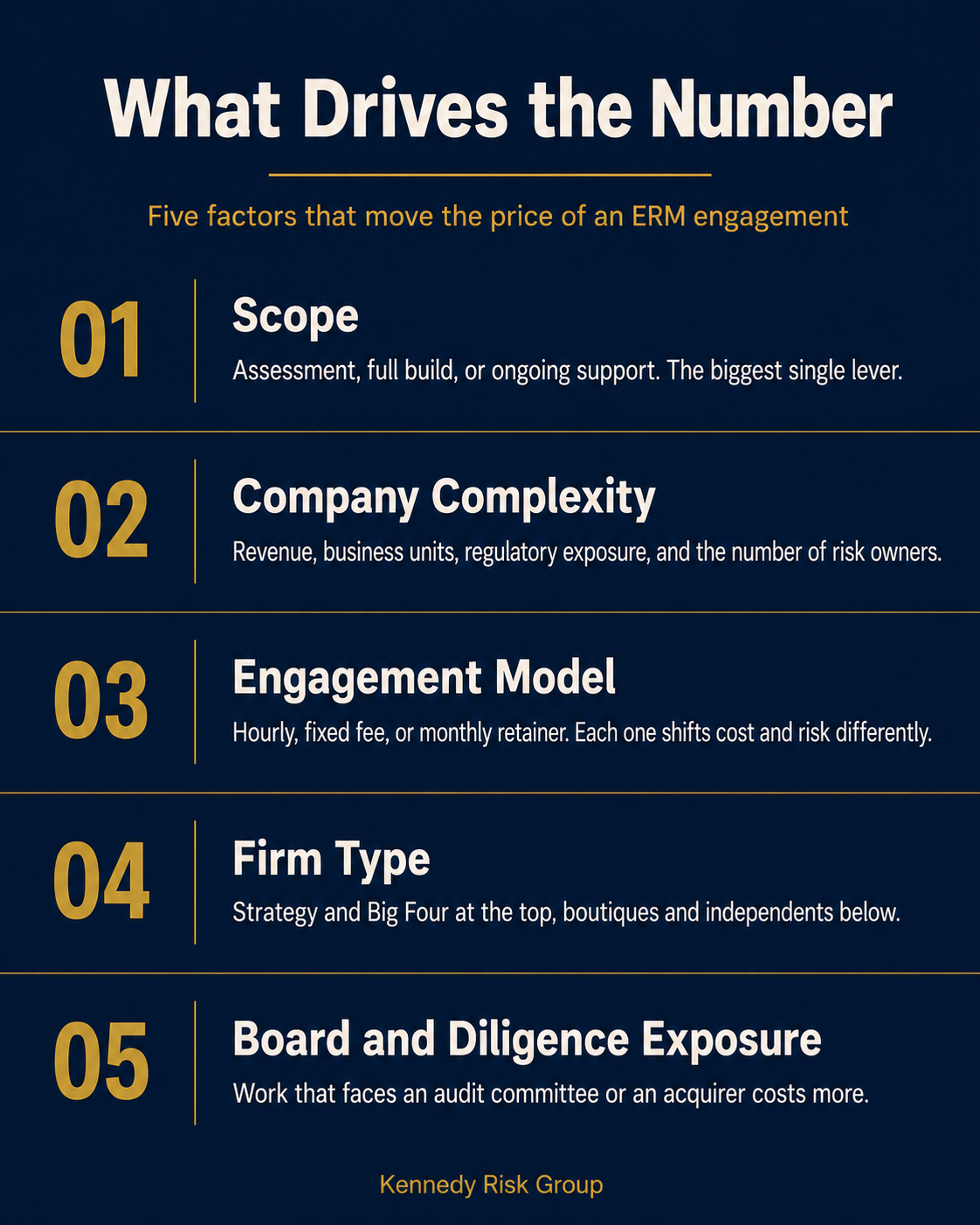
Five factors move the price more than anything else.
Scope is the largest lever, for the reasons above. Assessment, build, and ongoing are different orders of magnitude.
Company size and complexity. A single-entity company with a manageable risk profile is a far smaller engagement than a multi-unit business with regulatory exposure, international operations, or a long list of risk owners to interview and align. More surface area means more time, and time is what you are buying.
Engagement model. Hourly billing, fixed project fees, and monthly retainers price the same work differently and shift risk differently. Fixed fees are the preferred model among high-end firms because they cap your cost and make the budget predictable. Hourly arrangements can be cheaper for small, well-defined tasks, but they put the overrun risk on you.
Firm type. This is the driver most companies underweight. The same nominal task carries a very different price depending on whether a global strategy firm, a national boutique, or an independent practitioner does it, and a large share of a big firm's rate is brand, overhead, and the bench of junior staff supporting the work rather than the expertise applied to your problem.
Board and diligence exposure. Work that will be scrutinized by an audit committee, a private-equity sponsor, or an acquirer carries more cost, because it has to hold up under questioning. That premium is often worth it, but you should know you are paying for it.
What the market actually charges
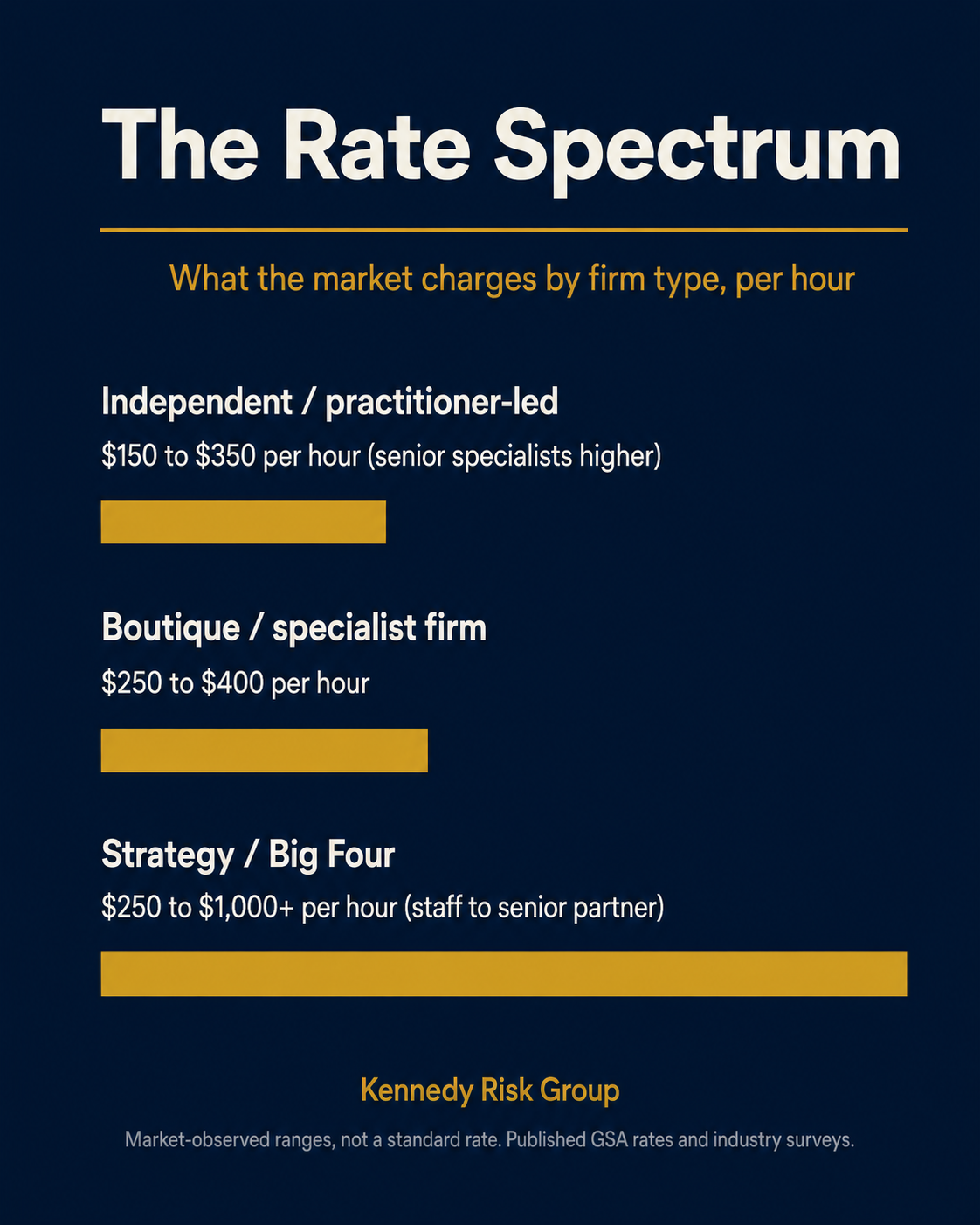
The clearest public window into the top of the market is government data. Large firms publish their rates on the U.S. General Services Administration (GSA) schedule, and those rates are a matter of record. Reported GSA pricing shows large strategy and Big Four firms billing staff-level consultants in the low-to-mid hundreds per hour, engagement leads in the $600 to $700 range, and senior partners past $1,000 an hour. The GSA's own labor rate tool lets you see the same fully burdened ceiling rates across vendors.
Below that tier, the numbers come down meaningfully. Boutique and specialist firms commonly run in the $250 to $400 per hour range. Independent and practitioner-led advisors span a wide band, often $150 to $350 per hour, with senior subject-matter specialists reaching $500 or more for high-value work. Ongoing advisory and fractional arrangements are usually priced as a monthly retainer, commonly in the $5,000 to $20,000 range depending on seniority and scope.
Treat all of these as market-observed ranges, not quotes. The point is not the exact figure. It is the spread. The gap between an independent senior practitioner and a strategy-firm partner can be three or four times the hourly rate for work that, in the mid-market, often does not require the larger firm's machinery.
How to think about budget
Translate the rates into the three engagement types and the picture gets practical.
A focused assessment is the smallest commitment, typically a fixed-fee project rather than an open-ended hourly arrangement. It buys you a clear read and a roadmap without committing you to a build.
A program build is the largest, scoped in weeks to months and usually priced as a fixed fee or a capped engagement. The range is wide because the work is, but the scope should be concrete enough before you sign that the number is too.
Ongoing advisory is the monthly retainer described above. For a mid-market company that needs continuity without a full-time hire, this is frequently the most cost-effective of the three, because you are paying for the workload you actually have rather than a permanent senior salary. We walk through that build-versus-buy decision in detail in our guide to whether to hire, build, or outsource risk.
What Kennedy Risk Group Charges
Everything above describes the market. Here is our own answer to it. We scope engagements tightly enough to name the price before the work starts, which is the practical response to the problem this article describes: when pricing is opaque, the buyer carries the risk of the overrun.
| Engagement | Fixed fee | Timeline |
|---|---|---|
| ERM program diagnostic | $4,500 to $6,500 | 1 to 2 weeks |
| Executive risk reporting build | $18,000 to $25,000 | 3 to 6 weeks |
| Targeted risk assessment | $22,000 to $27,000 | 4 to 6 weeks |
| Full ERM program build | $52,000 to $70,000 | 8 to 12 weeks |
Ongoing advisory is scoped and quoted separately.
These are fixed fees rather than estimates, and they hold for a company between $50M and $750M in revenue with a single-entity or lightly multi-entity structure. Complexity moves the number, which is exactly why the diagnostic exists: it establishes real scope before anyone commits to a build. The diagnostic fee is credited in full toward any engagement that follows.
Why the cheapest quote usually costs the most
The lowest number on the table is rarely the lowest cost. Three patterns explain why.
The first is junior staffing. A blended team that looks affordable on paper often means the senior name you met in the pitch is not the person doing your work. In a strategy firm's own rate sheet, the partner can cost three times the associate. If your engagement is staffed down to keep the price attractive, you are buying associate work at a discount, not expert work at a bargain.
The second is under-scoping. A quote can be low because it leaves out the parts that are hard. An assessment that does not interview the people who actually know where the risk sits, or a build that stops at a register and never reaches board reporting, produces a deliverable that looks complete and changes nothing. You pay again to finish it.
The third is shelf-ware. The most expensive ERM engagement is the one that produces a polished document nobody uses. If the work does not leave behind a program that runs, the entire fee was overhead. This is the failure mode that does not show up in the price comparison, and it is the one that matters most.
How to compare quotes apples-to-apples
To make two proposals comparable, hold the scope constant and ask the same questions of each. Who specifically does the work, and at what seniority. What the concrete deliverables are, named individually. What is explicitly out of scope. Whether the engagement ends with a document or a working program. And what ongoing support, if any, is built in after the build is done.
A firm that answers those questions plainly is showing you how it prices. A firm that cannot is the bigger risk, regardless of the number at the bottom of the page. Comparing quotes well goes hand in hand with how you choose the firm in the first place, and both deserve the same scrutiny.
The bottom line
ERM consulting does not have a price because it does not have a single product. What it has is a set of drivers you can read, and three engagement types you can budget against. The mistake is shopping on the headline number. The companies that spend well decide what outcome they need first, scope it honestly, and then compare quotes on staffing, deliverables, and whether the work leaves a program behind. Do that, and the cost question takes care of itself.
Where to Start
The cleanest way to right-size your spend is to know where your program actually stands before you scope anything. The KRG Board-Ready Risk Reporting Scorecard gives you a tier-level read in seven questions and about two minutes, with no email required to see your score. If you want an independent, practitioner-level assessment of your gaps and what it would take to close them, the ERM Program Diagnostic is a one-to-two-week engagement built for mid-market organizations, and the diagnostic fee is credited toward a larger engagement if you move forward.
Take the Board-Reporting Scorecard Explore the ERM Diagnostic
Frequently Asked Questions
How much does ERM consulting cost?
There is no standard rate, because the work is priced by scope. The practical way to budget is by engagement type. A focused assessment is the smallest commitment and usually a fixed fee. A full program build is scoped in weeks to months. Ongoing advisory support is typically a monthly retainer, commonly in the $5,000 to $20,000 range depending on seniority and scope. Hourly rates across the market span from roughly $150 an hour for an independent practitioner to past $1,000 an hour for a senior partner at a large strategy or Big Four firm, so the firm you choose matters as much as the work. Kennedy Risk Group publishes fixed fees for mid-market engagements: $4,500 to $6,500 for an ERM program diagnostic, $18,000 to $25,000 for an executive risk reporting build, $22,000 to $27,000 for a targeted risk assessment, and $52,000 to $70,000 for a full ERM program build.
Why is there such a wide range in risk consulting fees?
Five factors drive the spread: the scope of the work (assessment, build, or ongoing), the size and complexity of your company, the engagement model (hourly, fixed fee, or retainer), the type of firm (strategy and Big Four at the top, boutiques and independents below), and how much board or diligence scrutiny the work has to withstand. Because those variables move independently, two quotes for what sounds like the same project can differ by a wide margin and both be reasonable.
How much do Big Four firms charge compared to boutiques and independents?
Publicly published U.S. government (GSA) schedule rates show large strategy and Big Four firms billing staff-level consultants in the low-to-mid hundreds of dollars per hour, engagement leads in the $600 to $700 range, and senior partners past $1,000 an hour. Boutique and specialist firms commonly run $250 to $400 per hour, and independent or practitioner-led advisors often run $150 to $350 per hour, with senior specialists higher. A large share of a big firm's rate reflects brand, overhead, and a supporting bench rather than the expertise applied to your specific problem.
How much should a mid-market company budget for a risk assessment?
A risk assessment or diagnostic is the smallest of the three common engagement types and is usually priced as a fixed fee rather than an open-ended hourly arrangement. It buys a maturity read, a gap analysis, and a prioritized roadmap, without committing you to a full build. The right way to size it is by the seniority of who does the work and the depth of the interviews involved, not by the lowest number, since a thin assessment that skips the people who know where the risk sits will cost you again later. As a concrete reference point, Kennedy Risk Group's ERM program diagnostic is $4,500 to $6,500 over one to two weeks, and a targeted risk assessment is $22,000 to $27,000 over four to six weeks.
Is a project fee or a monthly retainer better for risk consulting?
It depends on what you need. A fixed project fee fits a defined, one-time outcome such as standing up a program or running a single assessment, and it caps your cost. A monthly retainer fits ongoing ownership, where an outside risk leader runs the program and the board cadence on a continuing basis. Companies that need continuity without a full-time hire usually find the retainer more cost-effective, because they pay for the actual workload rather than a permanent senior salary.