Risk Strategy
Reverse Stress Testing: Find the Cash Limit Before You Need It
Start with the cash threshold leadership cannot cross. Then test the conditions that could get the company there and whether the response would arrive in time.
By Eric Kennedy · Tue Sep 22 2026 · 9 min read

Reverse stress testing starts with an outcome the business cannot accept, then works backward to the conditions that could cause it. For a mid-market CFO, the useful result is a decision made while there is still time to act: change payment terms, defer a commitment, or arrange funding before the need becomes urgent.
A downside forecast asks whether the company can absorb the scenario management chose. It does not tell you whether a different combination of events would exhaust the room to maneuver.
That distinction matters when the answer to a cash problem is, "We would do something before it got that bad." The question worth asking is what, who can authorize it, and whether it would work soon enough.
Start with a specific outcome
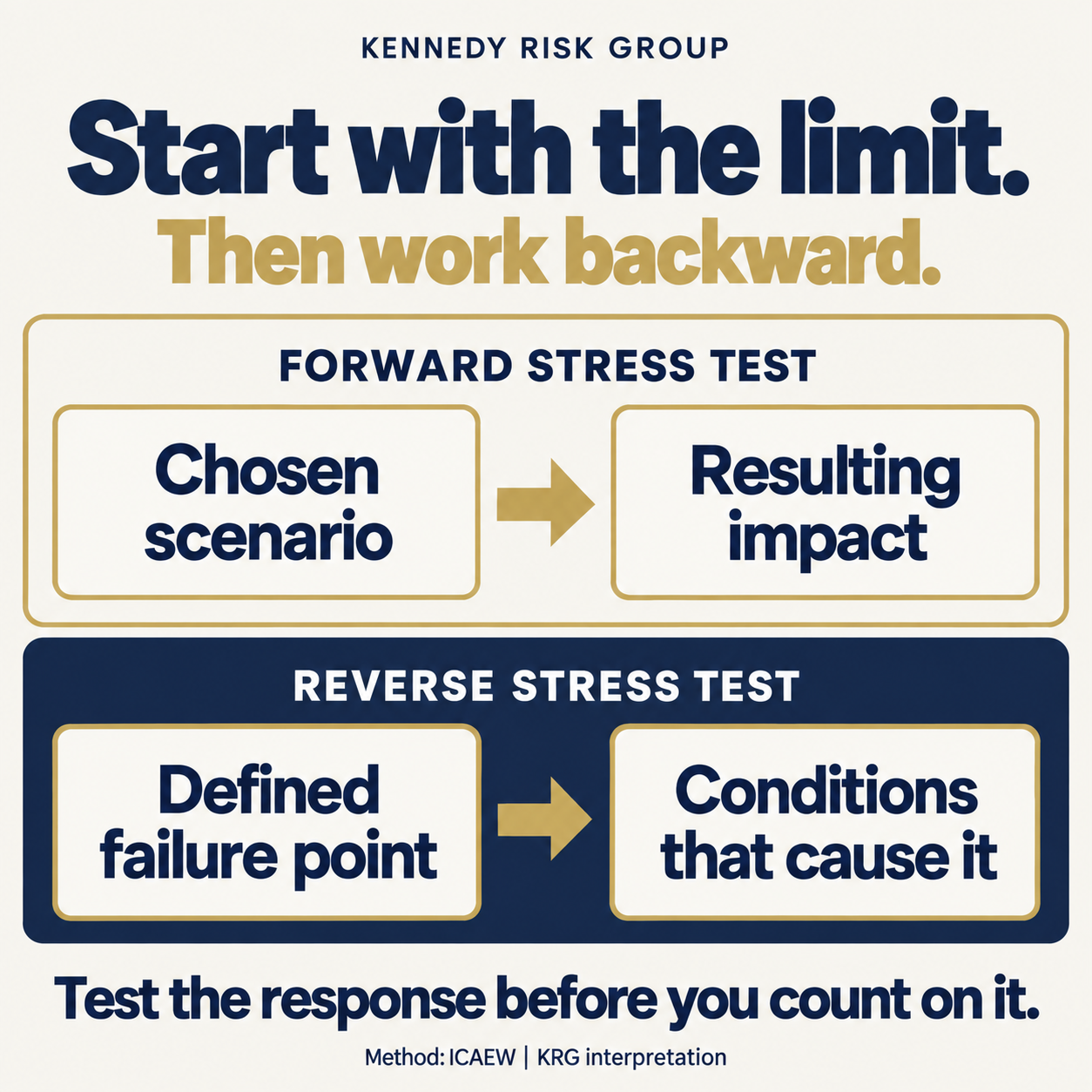
ICAEW's guidance on reverse stress testing, published April 16, 2025, distinguishes working backward from a defined outcome from applying a chosen shock and calculating its impact. It also warns that making a spreadsheet break is not enough. The circumstances need a credible business explanation.
The two approaches ask different questions:
- Forward stress test: chosen scenario, then resulting impact.
- Reverse stress test: defined failure point, then conditions that cause it.
Start with the limit. Then work backward. Test the response before you count on it. The graphic below is Kennedy Risk Group's interpretation of the method described by ICAEW, not a separate KRG framework.
For a first management exercise, choose an operating constraint narrow enough to test. That could be a cash floor needed to maintain normal payments through a seasonal trough. Write down the date, the amount, and what becomes impractical below it.
An operating cash floor is an early intervention boundary. Crossing it does not automatically mean the company is insolvent or its business model has failed. A full viability assessment can involve outcomes that a cash model alone cannot capture. Keep those distinctions explicit so the board does not mistake an early warning for a legal or accounting conclusion.
Do not choose a conveniently low floor just so the model passes. Ask treasury and the operating leaders to explain what the minimum supports. If nobody can explain why the number matters, settle that before testing it.
A cash example, with the timing made explicit
Illustrative scenario. A constructed mid-market distributor forecasts $8 million of unrestricted cash at the end of week eight. Management has set a $3 million operating cash floor for that date. The base case already includes scheduled payments, ordinary collections, and planned borrowing. This is not a KRG client engagement or an observed company result.
The reverse question is: what credible combination would reduce cash below $3 million by that date?
In this constructed scenario, a major customer's acceptance dispute delays $3 million of receipts until after week eight. Separately, an inventory supplier requires $2 million to be paid before week eight instead of later. The company also pays $1 million of incremental expediting costs before the same date to protect deliveries.
The calculation is $8 million minus $3 million minus $2 million minus $1 million, leaving $2 million. That is $1 million below the operating floor. Cash headroom can disappear even when the explanation consists partly of timing changes, not permanent losses.
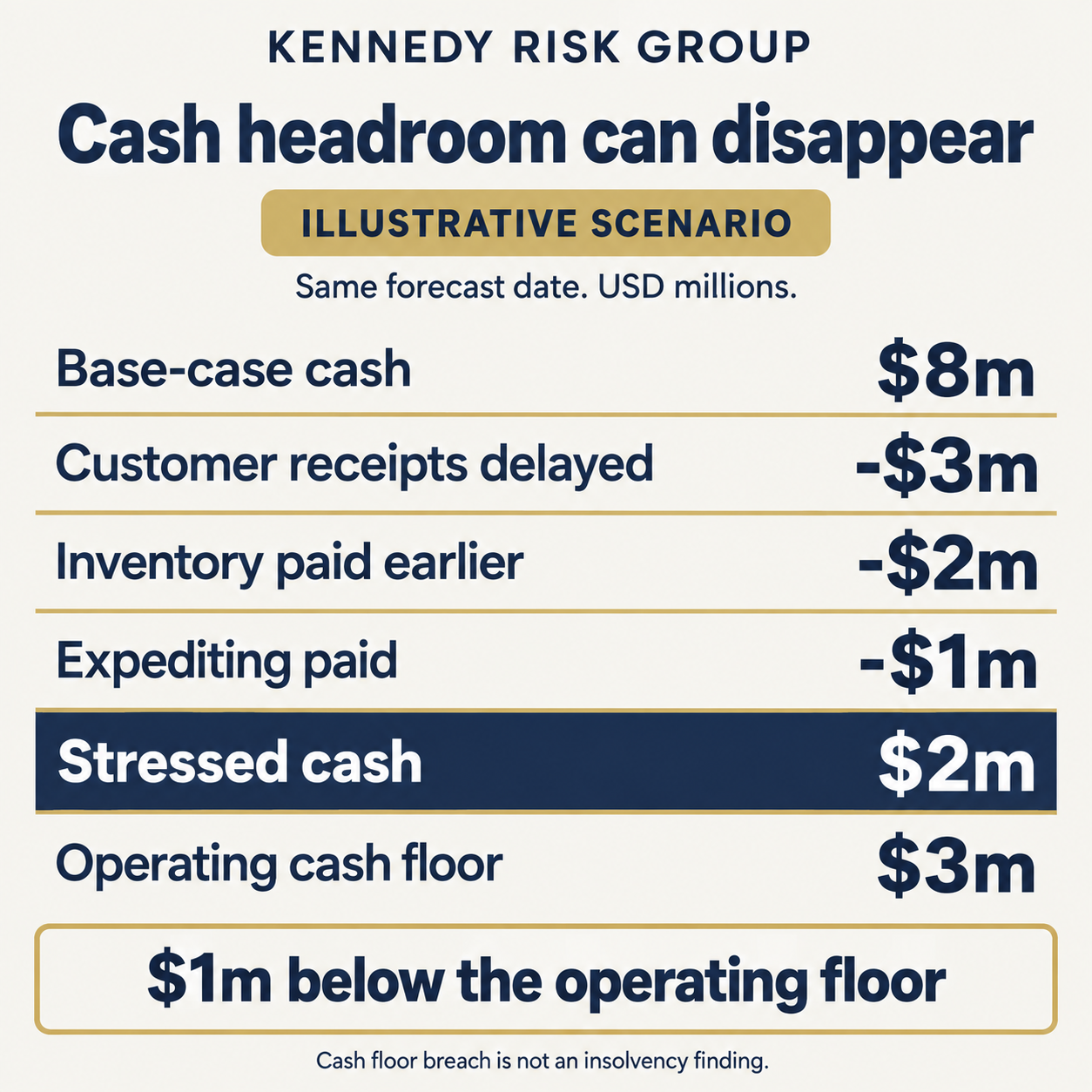
The arithmetic is deliberately simple. The harder work is deciding whether these events belong in the same story. Why would the customer dispute remain unresolved? What gives the supplier the ability to change terms? Would expediting actually protect the deliveries at issue?
A scenario assembled from unrelated worst cases can produce an alarming number without improving a decision. Document a plausible sequence, including which events share a cause and which merely overlap in time. This is where the existing KRG Risk Chain can help explain transmission. The reverse test then asks whether the resulting constraint crosses the chosen limit.
The table is a reconciliation of this particular example, not a model to reuse without checking its assumptions.
Cash reconciliation in detail
| Item | Effect at week eight | Modeling guard |
|---|---|---|
| Base-case cash | $8 million | Unrestricted cash after the payments, collections and borrowing already in the base case. |
| Customer receipts delayed | Subtract $3 million | Cash arrives after the test date. Do not also deduct the same amount as a permanent loss. |
| Inventory paid earlier | Subtract $2 million | An existing payment moves forward. It is not a second purchase. |
| Expediting paid | Subtract $1 million | Incremental cash paid by the test date, excluded from the other adjustments. |
| Stressed cash | $2 million | No unapproved rescue funding or speculative recovery proceeds included. |
| Operating cash floor | $3 million | The $1 million shortfall triggers a management decision, not an automatic insolvency conclusion. |
All amounts are illustrative and measured at the same forecast date. A real exercise should also inspect the path to that date. A balance that looks adequate at week eight may conceal a payment problem in week six.
Make each proposed response earn its place
The next version of the example often looks much better. Someone adds an asset sale, assumes the customer pays sooner, or inserts another draw on a credit line. The model returns above the floor.
Before accepting that version, ask the person responsible to explain how the cash arrives.
For the disputed receivable, the useful evidence is the acceptance condition, the person able to resolve it, and a credible payment date. "Sales will push harder" is not a cash assumption. For the accelerated inventory payment, procurement needs to establish whether the terms are negotiable and what happens to supply if the company refuses.
For new borrowing, have treasury verify the facility terms and availability under the stressed facts. A headline facility amount is not the same as funds the company can draw on the required date. Do not assume a lender will grant a waiver or that owners will contribute additional capital. Show contingent support separately until its conditions are understood.
This is not just a problem in small models. On July 31, 2026, the ECB reported results from a reverse stress test covering 110 supervised euro area banks. It identified some overly optimistic assumptions about selling loan portfolios or raising capital at ambitious prices in adverse markets.
That was a bank-supervision exercise, not a survey of US mid-market companies. It does not establish how often these weaknesses occur in KRG's target market. The transferable lesson is narrower: a response that depends on a willing counterparty needs to be tested under the same adverse conditions as the exposure.
Keep the unmitigated result visible beside the result after management actions. Otherwise, an optimistic recovery assumption can conceal the vulnerability the exercise was meant to find.
Put the decision date before the cash date
A response that takes longer than the available time is not a response for this scenario.
Return to the illustrative distributor. Suppose a proposed inventory change needs three weeks to implement. If the warning appears only one week before the cash floor is crossed, that change cannot solve the immediate problem. It might still help later, but the model must not credit it early.
ICAEW's practical guidance, reviewed April 16, 2025, specifically calls for considering the time available to react and implement mitigation. KRG's practical recommendation is to put a latest decision date next to each response, not just a completion date.
For each action, record the observable trigger, the decision-maker, the implementation time, and when cash actually changes. Work backward from the expected breach date, allowing time to detect the problem and obtain approval. If the schedule has no margin for delay, say so.
Finance can maintain the cash model, but it cannot validate every assumption alone. Sales knows the customer's acceptance dispute. Procurement knows what a supplier might agree to. Operations knows whether a delivery can move. Have those people challenge the assumption attributed to them before the result reaches the board.
The board discussion should then be specific: which action needs approval now, which remains conditional, and which supposedly available response has been removed from the model because the evidence does not support it?
When a simpler test is enough
Reverse stress testing is not automatically better than a conventional sensitivity analysis. If leadership is deciding whether one proposed price change covers one known input-cost increase, a direct calculation may answer the question with less effort.
Use the reverse approach when the real concern is an unacceptable outcome and management has not identified the combinations that could cause it. It is especially worth considering when several proposed responses depend on the same lender, customer, or operating resource.
Nor does a constructed path to a cash-floor breach tell you the probability of that breach. A model can show that conditions are sufficient without showing that they are likely. Record the evidence supporting plausibility, the assumptions still in dispute, and the range over which the conclusion changes. Do not attach a percentage merely because the reporting template asks for one.
The exercise should complement risk work in the budgeting process, not duplicate it. Budgeting tests the assumptions behind the chosen plan. This exercise starts with a limit and looks for a credible way the business reaches it, including combinations the original downside case left out.
Bring one decision back to the next review
Start with one outcome and the people who can explain the cash movements underneath it. Keep the calculations inspectable. If the discussion ends with several reassuring responses but no owner has checked whether they can happen in time, the work is unfinished.
The useful output is a decision record: the limit tested, the conditions that could cross it, the actions that still work, and the approval needed while those actions remain available. That is something an executive can act on without learning a new scoring system.
Does your reporting make that decision clear?
A cash threshold is useful only if the reporting gets a decision to the right people early enough. The Board-Ready Risk Reporting Scorecard is a starting point for checking whether your current reporting supports that conversation.
Take the Board-Ready Risk Reporting Scorecard
Frequently Asked Questions
What is reverse stress testing?
Reverse stress testing starts with a defined unacceptable outcome and works backward to identify credible conditions that could cause it. In this article, the example uses an operating cash floor as an early management intervention boundary. That narrower exercise is not a complete assessment of business viability.
How does reverse stress testing differ from a downside forecast?
A downside forecast starts with selected adverse assumptions and calculates the result. A reverse stress test starts with the result leadership wants to avoid and asks what conditions could produce it. The approaches complement each other. Neither a constructed scenario nor a threshold calculation establishes the probability of failure.
When should a mid-market company repeat a reverse stress test?
Revisit it when the tested limit, business model, funding arrangements, exposures or available responses materially change. A planning review can provide a useful opportunity, but repeating an unchanged calculation on a fixed schedule is not the objective. Management should decide the cadence based on how quickly the underlying conditions can change.