Enterprise Risk Management
The Near Miss You Reported as a Success
A clean loss report can hide a failed safeguard. Before calling a near miss a success, identify what stopped the loss and whether it will work again.
By Kennedy Risk Group · Thu Oct 15 2026 · 8 min read

A payment stopped minutes before release can earn a team congratulations and a closed incident. Neither tells the CFO whether the next payment is protected.
Near-miss risk management starts with a more useful question: what actually prevented the loss, and can we rely on it next time? A planned check, an improvised rescue and favorable timing can all produce the same zero in a loss report. They do not justify the same confidence.
That distinction matters when management decides whether to close an incident, fund a repair or lower a risk rating. If the successful escape becomes evidence that protection is adequate, the company can leave the underlying exposure intact.
A lucky outcome can improve the manager's review
An experiment by Robin Dillon, Catherine Tinsley and Edward Rogers put a project manager's decisions into a fictional spacecraft mission. Participants evaluated versions ending in success, a near miss or failure. In the near-miss and failure versions, the manager's decisions were the same; the spacecraft's orientation relative to the sun changed the outcome.
The near-miss manager received general decision-making evaluations similar to the successful manager, while the failed manager was judged more harshly. The 2006 paper, available through NASA, involved 24 NASA managers, 95 MBA students and 83 undergraduates. This was a scenario experiment, not a study of mid-market companies or an estimate of how often executives make this error.
Asking participants to evaluate specific decisions did not eliminate the bias in that study. A longer incident form is not an established cure.
The management implication is narrower than “people cannot learn from success.” Review the decision and the protection separately from the outcome. Otherwise, the same weak process may look acceptable on Monday and negligent on Tuesday because circumstances changed.
The same outcome. Different evidence.
For this discussion, a near miss is an event with a credible route to harm that was interrupted before that harm occurred. Record what happened before arguing over the label. A routine rejection by a functioning preventive control need not be treated as an incident requiring executive escalation.
The practical distinction is the mechanism that stopped the problem:
Designed control. The planned check stopped the error. Verify coverage and repeatability. Evidence might include an enforced approval hold, a documented review or a tested automatic rejection. A human check can be a designed control; automation is not the dividing line.
Improvised rescue. Someone caught it outside the process. Make the protection dependable. The person may have shown excellent judgment, but an intervention that depended on their being available, remembering an exception or noticing something outside their assigned work deserves a different assessment.
Favorable circumstance. Timing or chance prevented harm. Do not count it as a control. A customer happened to call before dispatch. A market movement happened to offset an error. Nothing in the process necessarily became safer.
One event can involve more than one mechanism. Trace the sequence far enough to identify which protection was necessary and which simply happened to be present.
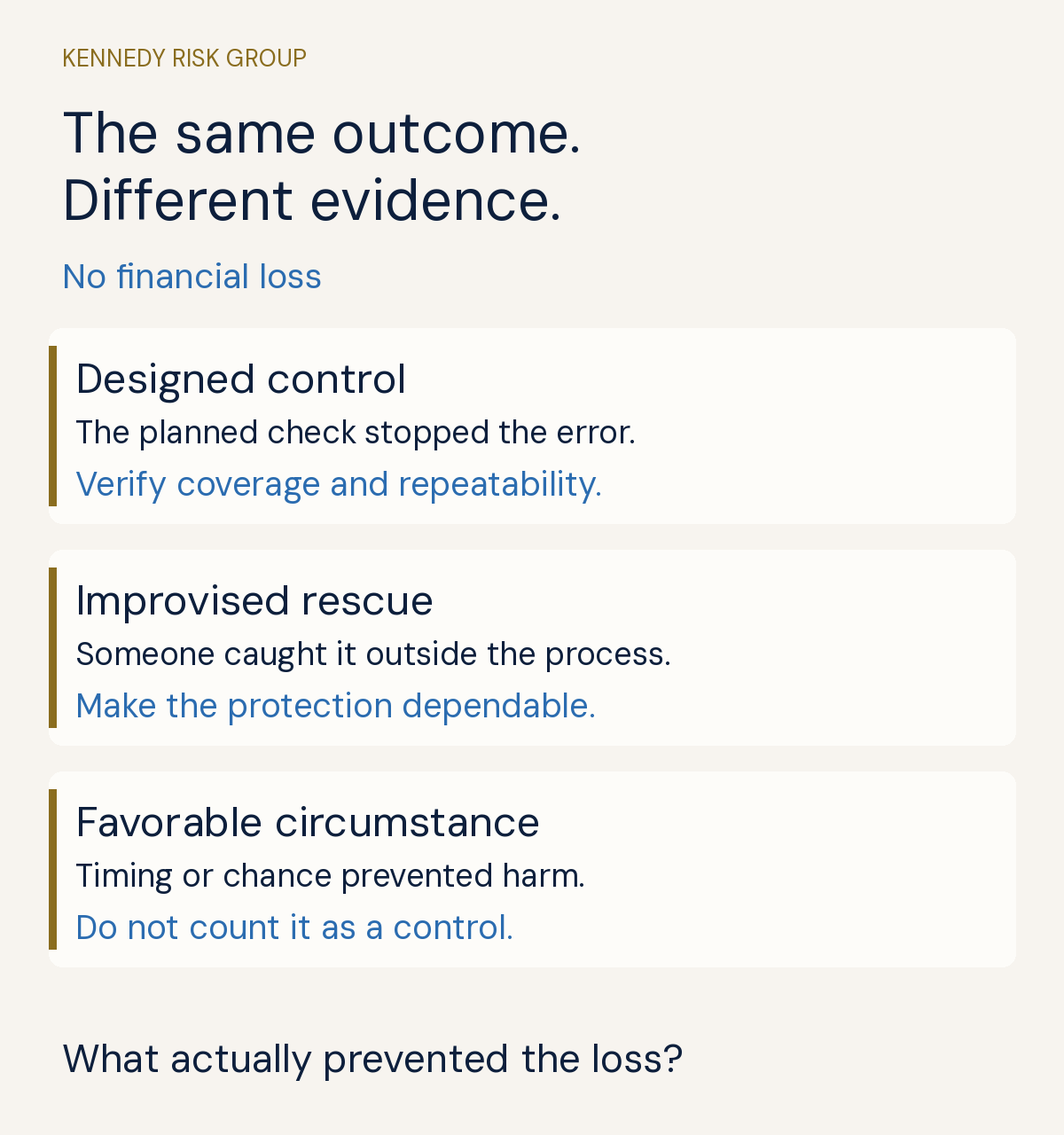
The graphic's central question is worth putting above the incident narrative: What actually prevented the loss? Answer it before writing “controls operated effectively.”
Keep the loss and the exposure separate
Illustrative scenario. A finance team receives a request to change a supplier's bank details. A required verification step is skipped. A $240,000 payment instruction is prepared, but an unscheduled call from the supplier reveals the problem before release. Funds lost: $0. Payment instruction at risk: $240,000.
The colleague who answered the call deserves credit. The verification process still failed in this constructed example.
The event record should preserve both facts. “No funds lost” is an outcome. “The verification step was skipped” is an observation about protection. Combining them into “no issue” discards the information management needs.
The immediate decision is to require and test verification before release. That means confirming how the payment is held, who performs the check, what evidence is retained and what happens if the usual reviewer is unavailable. A reminder email alone would not demonstrate that the gap is closed.
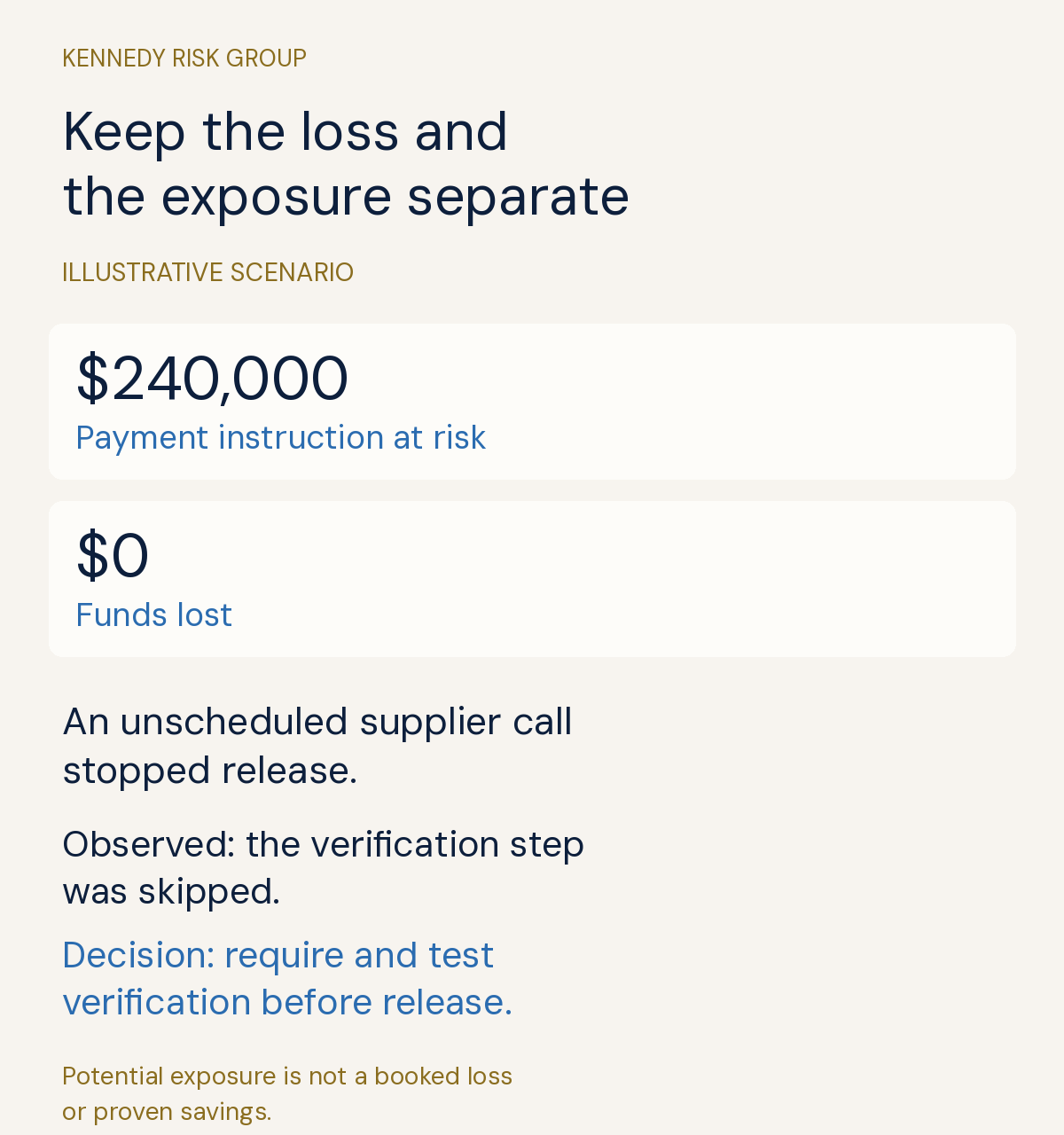
The $240,000 is not a booked loss, proven savings or an expected-loss estimate. It identifies the instruction exposed in the scenario. Whether the money would have left, whether it could have been recovered and what response costs arose are separate questions. Do not turn the largest imaginable consequence into the reported exposure.
For a real event, preserve the evidence behind the counterfactual: the instruction, approval status, release timing and remaining checks. If a later mandatory check would reliably have stopped it, that changes the interpretation. If nobody can establish what would have happened, report the uncertainty instead of inventing precision.
Ask for the evidence that could change the decision
A useful review should make it possible to disagree with the first explanation. Ask the process owner for a short account that answers the following questions in ordinary language.
Where did the event depart from the intended process? Identify the actual step, not “human error” as a stopping point. Was a check absent, bypassed, late or unable to detect this kind of problem? Was the process followed, but designed around an assumption that did not hold?
What stopped it, and was that protection expected to operate? Name the mechanism and the evidence. “An experienced team” is too broad. “The second reviewer held release after independently checking the changed bank details” is testable.
What would have happened without that intervention? Use a credible sequence, including other protections that still stood between the event and harm. This is where the KRG Risk Chain helps connect trigger, transmission, constraint and financial outcome without jumping straight from an error to a catastrophic number.
What protects the next transaction today? Separate the temporary safeguard from the permanent repair. Identify the decision-maker, the action owner and the evidence needed to close the action. If responsibilities are blurred, use the distinction between risk owners and action owners.
These questions are a proposed management practice, not an empirically validated intervention. Their purpose is to expose the reasoning so an executive can decide whether the remaining protection is adequate.
An illustrative closure note might say: “The release hold now requires an independently recorded verification. We tested both the normal reviewer and absence coverage. The owner approved closure based on that evidence.” It should not stop at “team reminded; no loss incurred.”
Do not escalate every caught error
There is an honest counterpoint. Controls exist partly to catch errors. Treating every successful catch as proof of a failing system creates noise and can pull attention from events that expose a material gap.
Use proportionate review. An expected rejection with evidence that the intended control worked may belong in routine process monitoring. A bypass of a required safeguard, a recurring rescue outside the process or reliance on favorable circumstances warrants a closer look. Escalate based on credible consequence, recurrence and the protection available now, using management's established authorities and risk appetite.
Counts alone will not settle the question. More recorded near misses might mean more problems, better reporting or a changed definition. Fewer might mean improvement or less visibility. Keep the reporting scope and transaction context visible before interpreting a trend.
There is precedent for taking events without losses seriously. In a 2016 speech about operational risk at the Federal Reserve Bank of New York, Joshua Rosenberg described collecting near-miss information where controls failed without an operational impact. That is an example of institutional practice, not a requirement imposed here on every business or proof of a particular financial return.
Nor is collecting the event the same as learning from it. The separate challenge of getting people to raise risks they already know about remains important. This review begins after the signal has reached management.
Reward the save. Decide what must change.
The colleague who prevents a loss and the process that needed rescuing deserve separate judgments. Thanking the person does not require declaring the process sound. Investigating the process does not require treating the person as the problem.
For the next executive risk discussion, bring one recently closed event that recorded no loss. Ask the owner to show the stopping mechanism and the protection available today. If those answers differ, decide whether the remaining exposure needs action or explicit acceptance. The board-ready risk reporting resource can help turn that decision into a concise management or committee update.
If your reporting records outcomes but leaves those decisions unclear, the KRG scorecard is a proportionate starting point for reviewing the wider risk process. It will not certify an individual control. It can help you identify where ownership, evidence and follow-through need attention.
Assess your risk management process
Frequently Asked Questions
Does every near miss mean a control failed?
No. A planned preventive control may have caught an expected error. Distinguish a functioning safeguard from a bypassed check, an improvised rescue or favorable circumstances. Review the sequence and remaining protections before deciding whether escalation is needed.
Should a near miss be recorded as a financial loss?
Record actual losses and response costs according to the applicable accounting and incident-reporting policies. Keep potential exposure separate. A payment that was stopped is not automatically a realized loss, proven savings or an expected-loss estimate.
What should executives ask before closing a near-miss review?
Ask what actually prevented harm, whether that protection was intended and repeatable, and what protects the next transaction today. Close an action against evidence of the agreed repair, or document the authorized decision to accept the remaining exposure.