Enterprise Risk Management
How to Set Risk Escalation Rules: Thresholds, Owners and Response Times
Set practical risk escalation rules with observable triggers, clear decision owners, response deadlines and an authority-based decision ladder.
By Eric Kennedy · Originally published Tue Nov 24 2026 · Updated Tue Nov 24 2026 · 7 min read

"Tell me if it gets worse" is not an escalation rule. It leaves the hardest judgment with the person who often has the least authority to make it: whether the change is serious enough to interrupt someone more senior.
A usable risk escalation rule states four things in advance: the observable condition, the person who receives it plus a backup, the response deadline, and the decision required. It moves the risk to the lowest level that has authority to decide. It does not automatically send every breach to the board.
Escalation is a decision route, not an alert
An indicator, a tolerance, an escalation rule, and a contingency plan do different jobs.
- A key risk indicator says what changed.
- Risk appetite and tolerance say what variation management is prepared to accept.
- An escalation rule says when information must move, who must decide, and how quickly.
- A contingency plan says what happens after a defined condition activates the plan.
That distinction matters. A red indicator without an escalation rule can produce more email but no decision. A tolerance breach without a named authority can trigger a meeting whose participants still cannot approve the response.
The UK government's current Orange Book calls for clear roles, appropriate escalation and delegation, and agreed triggers that bring significant issues to attention quickly. It is public-sector guidance, not proof that a particular escalation design improves results in a US mid-market company. The design principle still transfers: make the trigger and route explicit before the pressure arrives.
Start with the boundary the owner cannot cross
Do not start with a color on the heat map. Start with the boundary that changes who has authority to act.
Four boundaries are especially useful:
- Exposure boundary. Actual or forecast performance moves beyond an approved tolerance, covenant, customer commitment, safety limit, or other decision boundary.
- Time boundary. The next routine risk meeting occurs after the last practical moment to decide.
- Authority boundary. The response requires spending, customer terms, operating changes, public disclosure, or risk acceptance beyond the owner's delegated authority.
- Information boundary. A material assumption fails, evidence cannot be obtained, or uncertainty becomes large enough to change the decision.
COSO describes risk tolerance as acceptable variation in performance relative to an objective and says it is best measured in the same units as the objective. That makes the rule easier to observe. "Escalate if service gets materially worse" invites debate. "Escalate if projected recovery time exceeds the contracted service target" points to evidence and an existing commitment. COSO's guidance defines sound practice, but it does not establish a universal threshold for any company.
Write the rule in one sentence
A complete escalation rule can fit in one line:
IF [observable trigger], SEND TO [decision owner plus backup], BY [response deadline], TO DECIDE [specific choice].
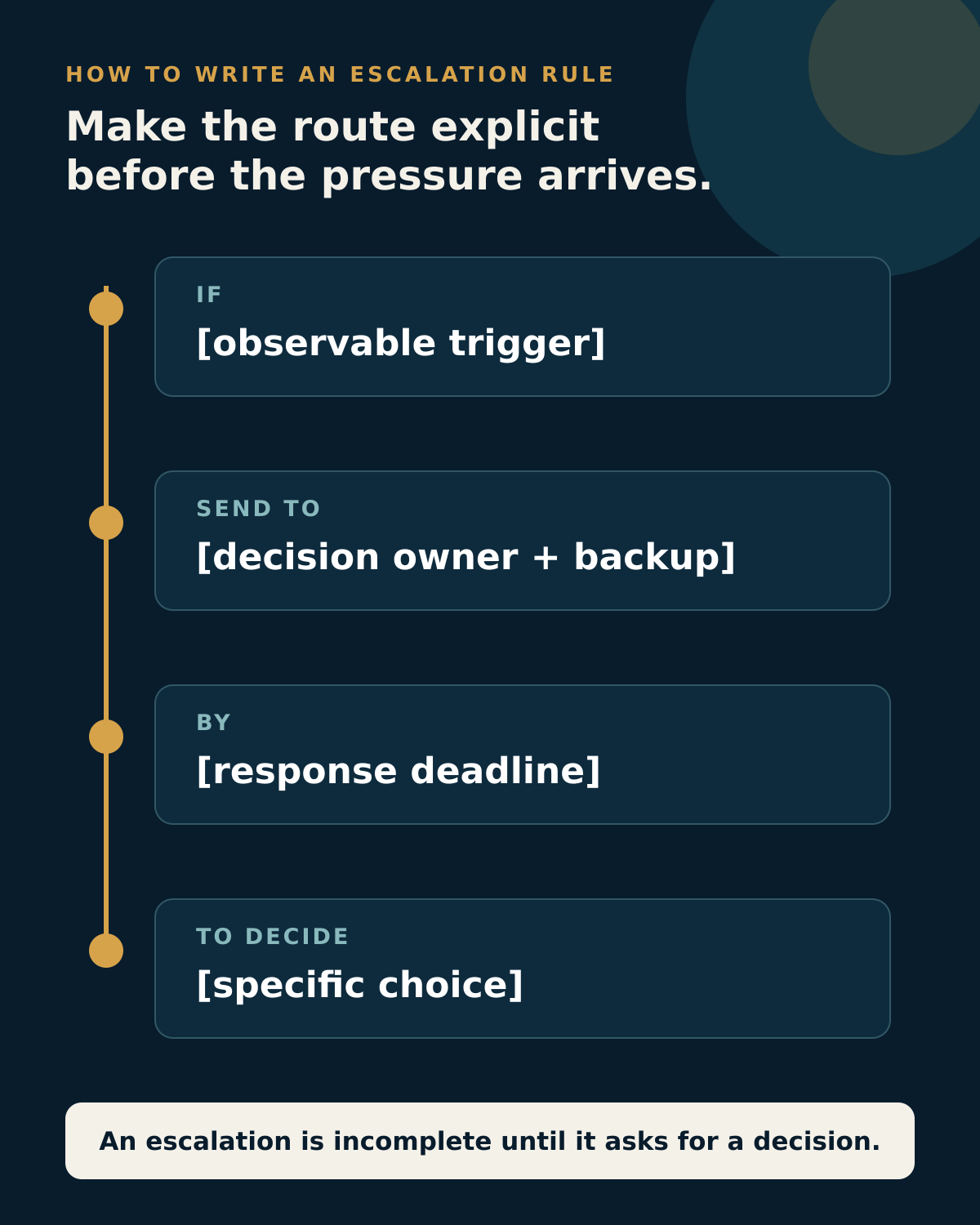
The last field is the one most often lost. "For awareness" is not a decision. The recipient should know whether management needs approval to spend, permission to accept exposure, a choice between response options, or authority to change a commitment.
Here is a constructed example:
ILLUSTRATIVE SCENARIO: If forecast gross margin for a product launch falls more than 150 basis points below the approved plan, or the recovery action requires more than $250,000 outside the approved budget, the launch owner sends the finance analysis to the CFO and COO by noon the next business day so they can decide whether to reprice, reduce scope, or request further authority.
The figures are not benchmarks. They show how a financial boundary, an authority boundary, a deadline, and a decision can work together. A company should replace them with its own approved limits and delegated authorities.
Build levels around authority, not heat-map color
Many escalation charts simply rename red, amber, and green. That can confuse severity with authority. A serious risk may remain within an executive's delegated authority. A smaller issue may need immediate escalation because it threatens a covenant, a regulatory deadline, or a customer promise.
The ladder below shows one way to separate decision levels. Every threshold and response time is illustrative.
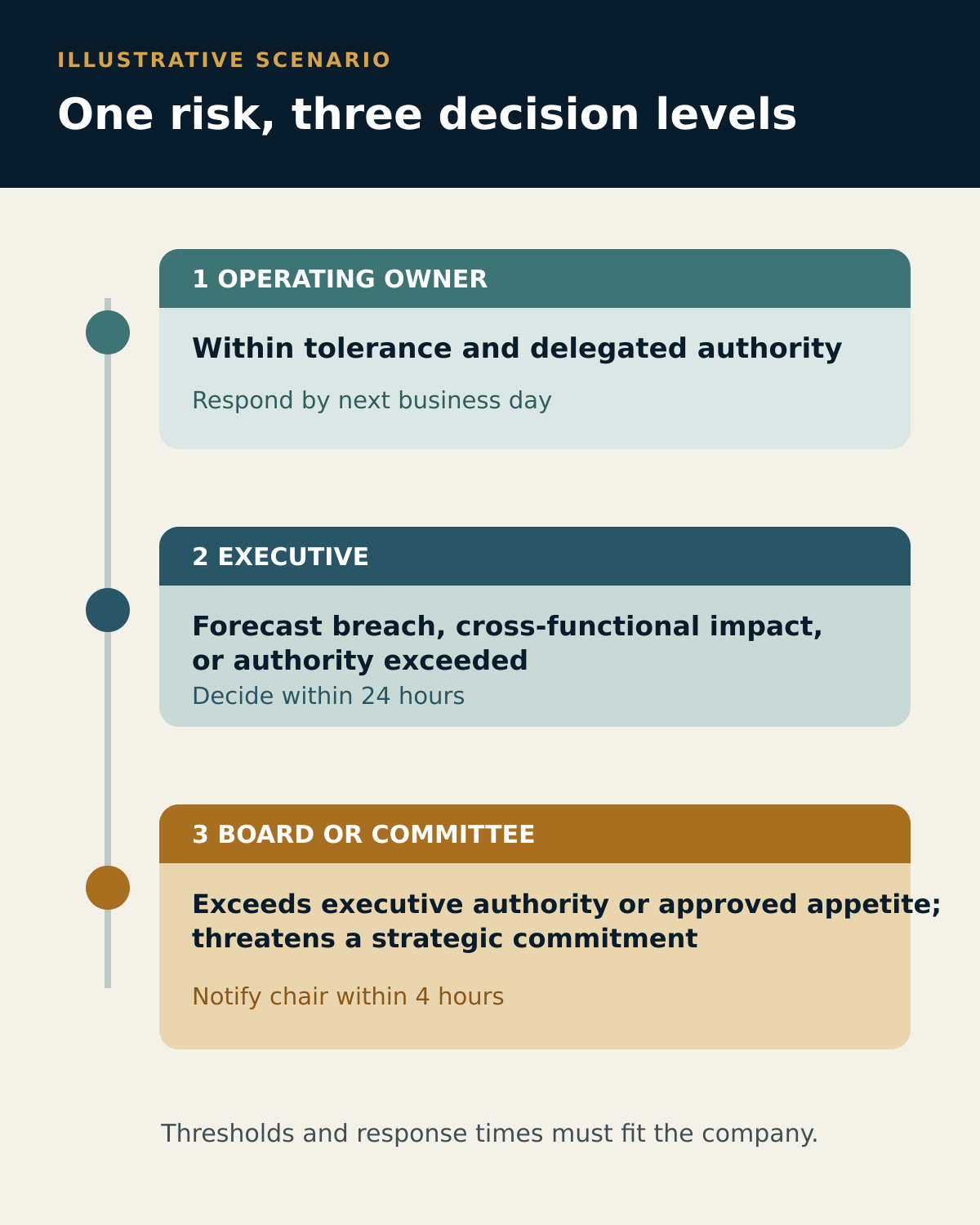
An illustrative authority ladder
| Decision level | Escalation condition | Illustrative response time | Expected decision |
|---|---|---|---|
| Operating owner | Exposure remains within tolerance and delegated authority | Respond by next business day | Choose and record an operating response |
| Executive | Forecast breach, cross-functional impact, or required action exceeds the owner's authority | Decide within 24 hours | Approve the response, accept exposure, or elevate the decision |
| Board or committee | Exposure exceeds executive authority or approved appetite, or threatens a strategic commitment | Notify the chair within 4 hours | Use the established governance path for the reserved decision |
This is not a recommendation that every organization use four hours or 24 hours. The timing should reflect how fast the exposure can change, when the decision loses value, and how the company's governance actually works. The route also needs a backup when the primary decision owner is unavailable.
Board escalation should be reserved for decisions or exposures that belong at that level. The board needs timely notice of matters that exceed management's authority, conflict with approved appetite, or threaten a commitment it oversees. It does not need to become the operating incident desk.
Send a decision packet, not a document dump
An escalation packet should let the recipient decide without reconstructing the risk from scratch. Five items are usually enough:
- What changed: the event, indicator, forecast, or failed assumption.
- Evidence: the source, timestamp, and known limitations.
- Boundary: the tolerance, authority, commitment, or deadline at risk.
- Decision required: the specific choice and the latest useful decision time.
- Recommendation: the owner's proposed action, tradeoff, and residual exposure.
This packet can be a short message, not a new presentation. If the issue reaches a board or committee, the same facts can feed a board-ready risk report without creating a separate version of the truth.
NIST's Cybersecurity Framework 2.0 implementation examples use a similar design principle in a narrower setting: contingency plans should define communication, prioritization, escalation, and elevation criteria. Cyber guidance does not set enterprise-wide escalation rules, but it reinforces the value of deciding the route before an event occurs.
Test the rule against predictable failure modes
Before approving an escalation rule, look for these defects:
- The trigger is an adjective. Words such as "material," "significant," and "concerning" need an observable condition or a named judgment owner.
- The recipient list has no decision owner. Copying six leaders can leave all six waiting for someone else.
- The deadline says "promptly." Tie the response to a clock, business day, or decision window.
- Every breach goes to the top. Escalate to the lowest level with authority to decide, then elevate only when the decision exceeds that authority.
- The record ends at notification. Capture the decision, rationale, owner, due date, and any temporary acceptance of exposure.
- There is no exit rule. State when the issue returns to routine monitoring and when an interim decision expires.
There is an honest counterpoint: more escalation can make risk management worse. If thresholds are too sensitive, leaders see repetitive alerts, owners stop distinguishing signal from noise, and genuine exceptions compete with routine variation. Review near misses and false alarms. Tighten a late rule and relax an overactive one, but document why.
Culture also matters. A precise route will not work if people are punished for carrying credible bad news. Leaders should challenge weak evidence and poor judgment without making silence the safer choice.
A 30-minute escalation-rule test
Use three of the company's top risks, not the whole register.
For each risk, write one sentence using IF, SEND TO, BY, TO DECIDE. Then test it against one recent event or plausible near miss:
- Would two reasonable owners recognize the same trigger?
- Does the recipient have authority to make the stated decision?
- Is there a backup?
- Does the deadline arrive before the decision loses value?
- Can the owner assemble the five-item decision packet from existing evidence?
Any "no" identifies a specific design gap. Fix those three rules first. The pattern will be easier to extend after leaders see what a complete escalation route looks like.
The Risk Reporting Scorecard can help identify where current reporting stops at status and fails to support a timely decision. Use it to choose which escalation routes deserve attention first.
Take the Risk Reporting Scorecard
Frequently Asked Questions
What is a risk escalation process?
A risk escalation process is the agreed route for moving a risk decision beyond its current owner. It defines the trigger, decision owner and backup, response deadline, evidence required, and decision to be made.
What should trigger risk escalation?
Useful triggers include an actual or forecast tolerance breach, a deadline that cannot wait for routine reporting, a response beyond the owner's delegated authority, or an information gap that materially changes the decision. The trigger should be observable or assigned to a named judgment owner.
When should a risk go to the board?
A risk should reach the board or a committee when the exposure or decision falls within its reserved authority, conflicts with approved appetite, or threatens a strategic commitment it oversees. Routine operating decisions should stay with management.
Who owns risk escalation?
The risk owner is normally accountable for recognizing and initiating escalation. The escalation rule should also name the person with authority to decide, a backup, and the party responsible for recording the decision and follow-up.