Governance, Risk & Compliance
The New CFO Mandate: Why GRC Is Now a Financial Discipline
Reactive compliance is a financial liability. The CFOs winning today are treating governance, risk, and compliance as a quantitative valuation lever, not a back-office cost.
By Eric Kennedy · Fri Apr 17 2026 · 9 min read

The CFO role has fundamentally shifted. While financial leaders once focused primarily on reporting and cost control, the modern mid-market CFO is now expected to act as a strategic risk architect. This involves connecting governance, regulatory exposure, and operational risk directly to enterprise value. Engaging in governance risk and compliance consulting is no longer optional; it's a strategic imperative.
This shift changes everything about how compliance is resourced, prioritized, and measured.
Reactive compliance, the "fix it when the regulator knocks" approach, isn't just inefficient. It's a financial liability. Mid-market firms lack the balance sheet depth of large enterprises to absorb regulatory penalties, legal exposure, or the operational disruption that follows a compliance failure. Every dollar spent recovering from a preventable breach is a dollar not building competitive advantage.
This is precisely why forward-thinking CFOs are engaging in governance, risk, and compliance consulting not as a back-office cost but as a valuation lever. A structured compliance program reduces risk premiums, strengthens audit defensibility, and signals operational maturity to investors, lenders, and strategic partners.
The question worth examining is whether that investment actually holds up financially, and the numbers are more compelling than most CFOs expect.
The Exponential Cost of Regulatory Failure vs. Program Maintenance
The math here is unambiguous, and CFOs who've looked at it closely rarely need further convincing. Research consistently shows that the cost of non-compliance runs approximately 2.71 times higher than the cost of maintaining a structured compliance program. That multiplier alone reframes the entire budget conversation around GRC.
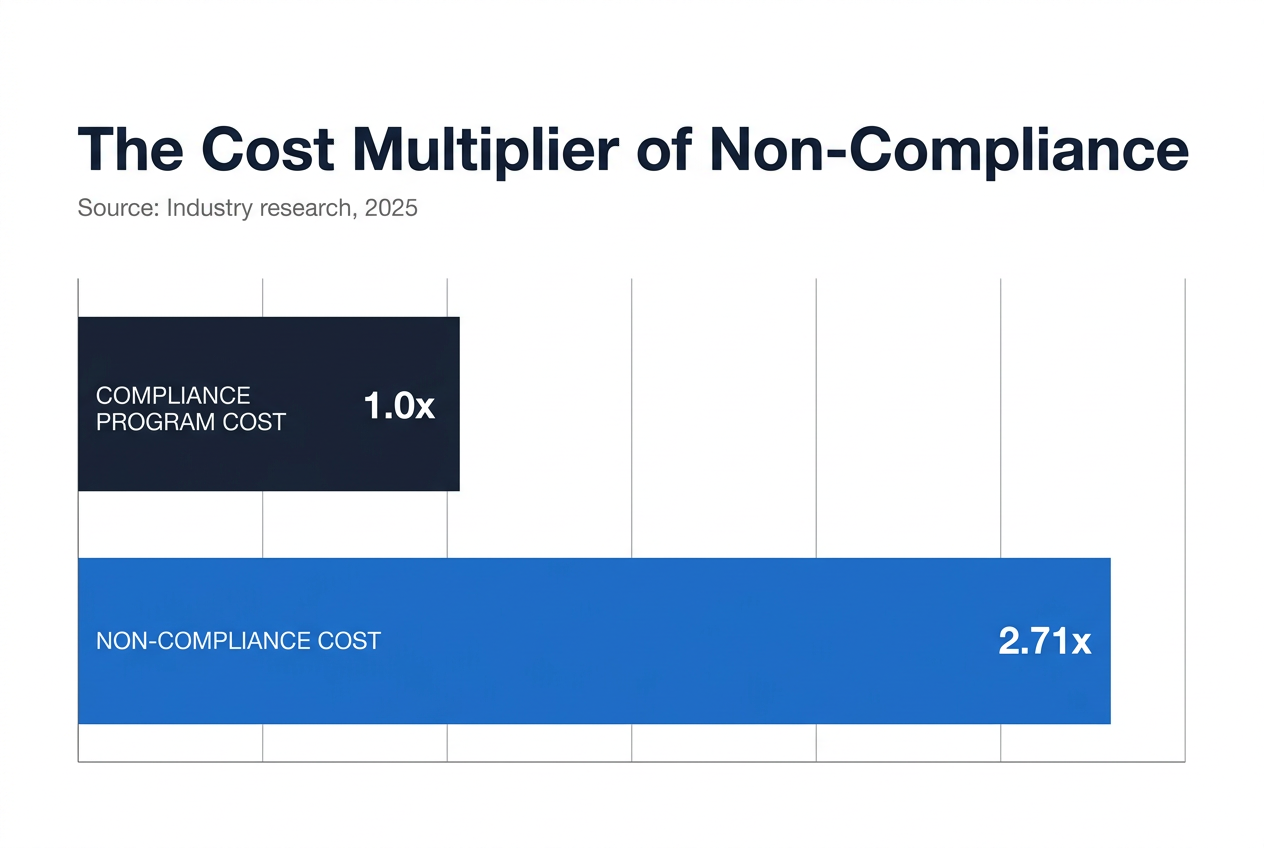
A study from the Ponemon Institute in 2025 revealed that organizations with comprehensive compliance programs saved an average of $2 million annually on potential fines and remediation costs. Yet many mid-market organizations still treat compliance spending as overhead to minimize rather than risk capital to deploy strategically. That's a miscalculation with real financial consequences.
Beyond Fines: The Revenue Exposure CFOs Often Miss
Regulatory fines are visible and quantifiable. What's harder to capture on a balance sheet, but equally damaging, are the hidden costs of non-compliance: contract terminations, lost procurement opportunities, insurance premium increases, and the operational drag of remediation efforts conducted under pressure.
Reputational damage is where the exposure becomes severe. Industry data suggests that organizations experiencing significant compliance failures can face revenue impacts in the range of 15 to 25 percent, driven largely by erosion of client trust and the departure of key relationships. In mid-market B2B environments where a handful of anchor clients represent a disproportionate share of revenue, that's an existential exposure.
This is precisely why enterprise risk management consulting services have shifted from a nice-to-have to a line-item defense strategy for finance leaders who understand their actual risk profile.
The challenge isn't convincing CFOs that compliance has financial value. It's giving them the analytical framework to measure it accurately, which is where the conversation turns from qualitative judgment to quantitative rigor.
From Qualitative to Quantitative: The Shift in Risk and Compliance
The previous section made clear that reactive compliance is expensive. But there's a deeper problem many mid-market organizations carry quietly: their entire approach to risk and compliance management is still built on qualitative judgment rather than financial measurement.
That has to change.
The Problem with Gut-Feel Risk Assessments
In organizations generating hundreds of millions in annual revenue, "high, medium, low" risk ratings aren't a methodology. They're a guess dressed up in a matrix. When a CFO asks how much financial exposure a specific regulatory gap represents, "it's a medium risk" isn't an answer. It's a placeholder.
Qualitative risk assessments mask real dollar exposure. They create the illusion of oversight without the precision that financial decision-making actually demands. For a CFO managing capital allocation, that's not governance. It's noise.
Translating Threats into Dollar-Denominated Exposure
Quantitative risk analysis changes the conversation entirely. Instead of abstract ratings, executives see scenario-modeled loss ranges: the probable maximum impact of a data breach, the estimated cost of a failed audit, the revenue exposure tied to a specific compliance gap.
This is the language finance runs on. When risk carries a dollar figure, it can be weighted against mitigation costs, factored into planning cycles, and presented to boards with the same rigor as any capital expenditure.
In practice, that single shift, from ratings to dollar ranges, is what turns a compliance gap from a vague worry into a number leadership can actually weigh against the cost of fixing it.
Real-Time Reporting Through Integrated Risk Management
Integrated risk management solutions close the gap between risk identification and executive action. Rather than quarterly snapshots compiled from disconnected spreadsheets, finance and audit leaders can access real-time dashboards that reflect current exposure across operational, regulatory, and financial risk categories.
The result is a risk function that runs in parallel with the business, not behind it.
That operational clarity has value beyond compliance. It directly shapes how investors and stakeholders perceive the organization's management maturity, a point the next section addresses in measurable terms.
Enterprise Risk Management as a Market Valuation Lever
The shift from qualitative risk reporting to quantitative discipline has a direct consequence that CFOs and board members can't afford to overlook: structured enterprise risk management consulting materially affects how the market values a business.
Research indicates that companies with mature ERM programs can command a valuation premium compared to peers operating without one. According to industry analysts at Gartner, firms with robust ERM practices can see valuation premiums of up to 20 percent due to decreased perceived risk.
When investors and acquirers evaluate a mid-market firm, they're not just pricing earnings. They're pricing predictability. A well-governed organization signals lower execution risk, fewer regulatory surprises, and more resilient cash flows. That combination compresses risk premiums and expands price-to-earnings multiples.
This is where governance, risk, and compliance consulting moves from a back-office cost to a front-office investment thesis. Proactive compliance risk assessment services don't just identify gaps. They generate the documented, auditable evidence that sophisticated buyers and capital partners demand during due diligence.
ERM also sharpens strategic decision-making in ways that quarterly reviews rarely capture. When leadership understands its risk appetite in concrete terms, not just as a policy statement, capital allocation, M&A targeting, and market expansion decisions become measurably better. Risk-adjusted thinking replaces instinct.
The organizations that treat GRC as a financial discipline tend to exit at higher multiples, attract better credit terms, and face fewer surprises at the closing table.
The valuation argument is compelling on its own. But realizing those benefits requires more than intent. It demands a structured approach to implementation. That's exactly where a practical framework makes all the difference.
Implementing Compliance Risk Assessment Services: A Practical Framework
ERM valuation benefits don't materialize on their own. They follow disciplined execution, and for mid-market organizations, that execution starts with three non-negotiable steps.
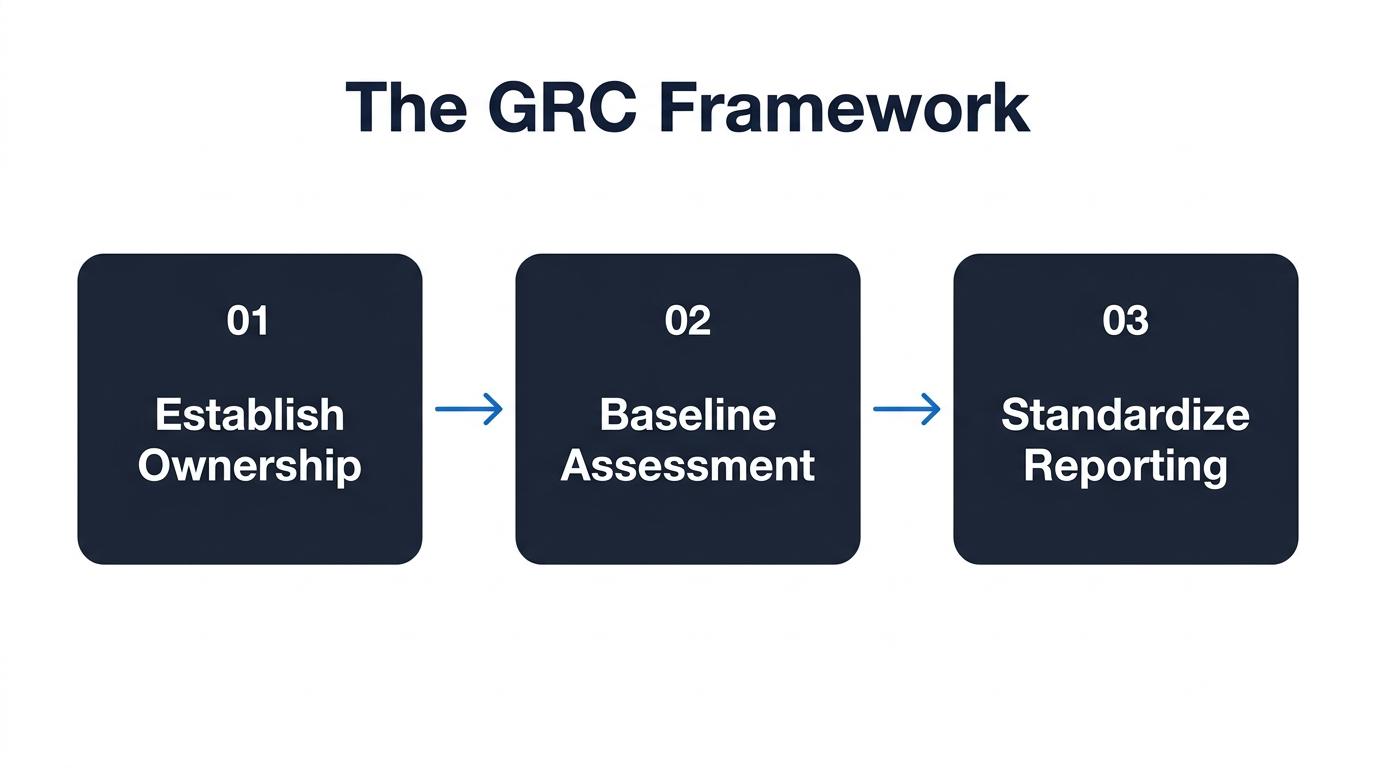
Step 1: Establish Executive Ownership
Compliance risk management without clear ownership is compliance risk management in name only. The CFO, Head of Internal Audit, or a designated risk officer must hold explicit accountability, not a shared responsibility that gets diffused across departments. When ownership is ambiguous, gaps go unaddressed and exposure compounds quietly.
In practice, this means embedding risk accountability into executive performance metrics, not just organizational charts.
Step 2: Conduct a Baseline Risk Assessment
Before your organization can close gaps, it needs to know where they are. A structured baseline compliance risk assessment surfaces high-exposure vulnerabilities across financial controls, regulatory obligations, and operational processes. This isn't a one-time audit. It's the foundation that makes everything else measurable.
A common pattern is discovering that the highest-risk areas aren't where leadership assumed they were.
Step 3: Standardize Reporting Through a Financial Risk Management Handbook
Integrated risk management solutions only deliver sustained value when reporting is consistent and repeatable. A standardized handbook covering escalation thresholds, risk owners, and review cadences transforms compliance from an episodic event into an ongoing discipline.
This framework positions your organization well for what matters most: turning compliance maturity into a genuine competitive advantage.
Key Takeaways
- Governance risk and compliance consulting is now a CFO-level financial discipline, not a back-office cost center.
- The cost of non-compliance runs roughly 2.71 times the cost of maintaining a structured program; reputational damage can erode 15 to 25 percent of revenue.
- Qualitative "high, medium, low" risk assessments mask real dollar exposure and fail to meet the standard finance leaders apply to every other capital decision.
- Mature enterprise risk management programs can command valuation premiums of up to 20 percent at exit and through capital markets.
- A practical framework, ownership, baseline assessment, and standardized reporting, converts intent into measurable financial outcomes.
Conclusion: Turning Compliance Into a Competitive Advantage
GRC was never meant to be a legal burden passed from the general counsel's office to the finance team on the eve of an audit. It's a financial discipline, one that shapes capital allocation, investor confidence, and long-term organizational resilience.
Structured financial risk management solutions, applied with rigor, are one of the most underutilized valuation levers available to mid-market organizations. The CFOs who recognize this aren't just protecting the business. They're building it.
Structured enterprise risk management compounds over time. The programs that treat risk as continuous financial intelligence are the ones that stop absorbing the cost of preventable surprises. The practical framework exists. The valuation case is clear. What separates execution from intention is the discipline to treat risk assessment and compliance not as annual checklists, but as continuous financial intelligence.
Kennedy Risk Group works with mid-market finance and audit leaders to evaluate ERM maturity, identify gaps that carry real financial exposure, and implement right-sized solutions that don't require enterprise-scale bureaucracy. If your organization is ready for a candid assessment of where your GRC program stands, and what it could be doing for your bottom line, reach out to Kennedy Risk Group to start that conversation.
Frequently Asked Questions
What is governance risk and compliance consulting?
Governance risk and compliance consulting helps organizations design and run an integrated program that connects board-level governance, regulatory compliance, and enterprise risk management. For mid-market CFOs, it converts compliance from a reactive cost center into a measurable financial discipline.
How do compliance risk assessment services differ from a standard audit?
A standard audit confirms whether existing controls are operating as designed. Compliance risk assessment services go further: they quantify the financial exposure tied to each regulatory or operational gap, prioritize them by dollar impact, and feed the results directly into capital allocation and board reporting.
Why is enterprise risk management consulting valuable for mid-market companies?
Mid-market firms lack the balance sheet to absorb large compliance failures and often face the same regulatory exposure as much larger competitors. Enterprise risk management consulting builds a right-sized program that protects valuation, supports financing, and improves M&A readiness without enterprise-scale bureaucracy.
How quickly can a CFO see results from improving risk and compliance?
Most organizations see measurable progress within one to two quarters: a clear baseline of quantified risks, improved board reporting, and reduced exposure on the highest-priority gaps. Valuation and credit benefits typically follow as the program matures over twelve months.
What is the first step to building a quantitative GRC program?
Start with a baseline risk assessment that translates each major risk into a dollar-denominated exposure range. From there, assign clear executive ownership and standardize reporting cadences so the program becomes a continuous source of financial intelligence rather than an annual checklist.