Risk Management
Corporate Security Is Not a Technology Problem. It's a Governance Problem.
Most mid-market companies respond to a security incident by buying more technology. The real failure point is the governance layer above it.
By Eric Kennedy · Tue Apr 28 2026 · 5 min read

Most mid-market companies treat corporate security as a technology problem. They buy tools, hire engineers, run scans, and assume they have addressed enterprise security risk management. But the failures that actually damage organizations, regulatory penalties, board-level credibility loss, lender concerns, customer churn after a breach, almost never trace back to the technology layer. They trace back to governance.
This is the structural blind spot in most regulatory compliance consulting and risk and compliance consulting engagements: the assumption that security is something IT owns and finance reviews quarterly. That model worked when cybersecurity was a contained operational risk. It does not work when security failures trigger SEC disclosure obligations, multi-state breach notification requirements, and material reputational exposure.
The distinction matters because it changes who needs to be accountable, what gets measured, and how decisions get escalated. A technology program optimizes for fewer vulnerabilities. A governance program optimizes for defensible decisions. These are not the same thing, and conflating them is why mid-market organizations keep getting surprised by exposures their IT teams technically knew about.
What Corporate Security Actually Requires
Strategic risk management treats corporate security as one component of an integrated risk portfolio, not a standalone technical discipline. That reframing changes everything about how the program is structured.
When security is positioned as a technology function, the conversation centers on patches, perimeter defense, and incident response. When it is positioned as a governance function, the conversation centers on risk appetite, escalation thresholds, financial quantification of exposure, and board-level reporting cadence. The technical work still happens, but it serves a governance structure rather than substituting for one.
According to ISACA's State of Cybersecurity report, fewer than half of organizations report that their security programs are fully aligned with business objectives. The rest are running security as a parallel function, technically active but strategically disconnected.
The Three Governance Gaps That Create Exposure
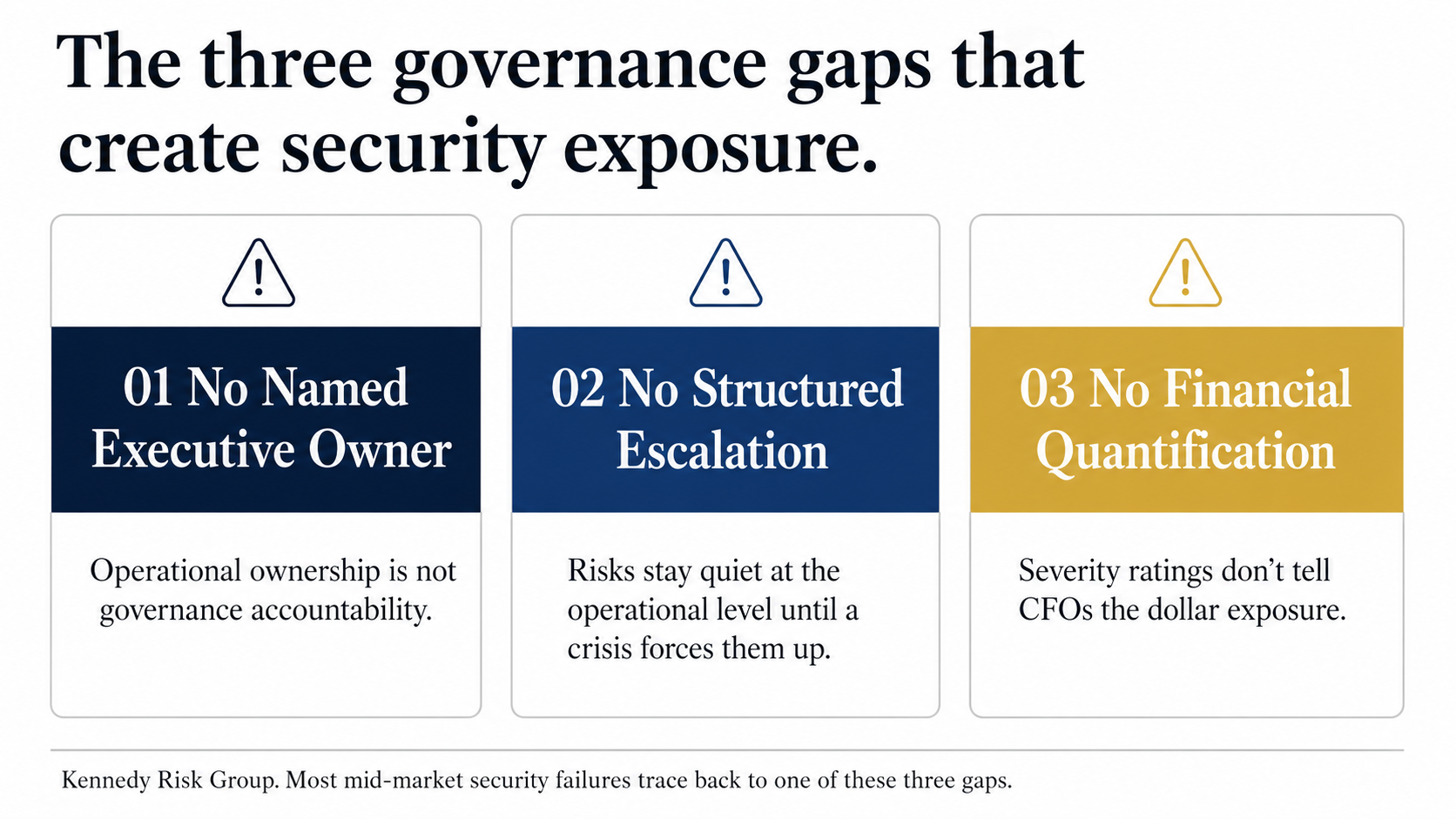
Most mid-market security failures trace back to one of these three gaps.
Security risk has no named executive owner
In most mid-market organizations, the CISO or IT Director owns security operationally. But operational ownership is not the same as governance accountability. When a significant security exposure emerges, who is responsible for deciding how much risk the organization will accept, what mitigation spend is justified, and when the board needs to be notified?
In organizations without a clear answer to that question, those decisions get made informally, inconsistently, and often too late.
Security escalation is reactive, not structured
Mature security governance defines escalation thresholds in advance. When a vulnerability reaches a certain severity level, or when a third-party breach affects a named vendor, there is a protocol: who gets notified, in what timeframe, with what information, and what decisions need to be made.
Without that structure, security teams manage exposures quietly at the operational level until something forces it upward. By the time it reaches a CFO or CEO, the window for proactive action has typically closed.
Security risk is not quantified in financial terms
Boards and CFOs make decisions in dollars, not severity ratings. A vulnerability classified as "high" in a CVSS score does not tell a finance leader what the expected financial impact of exploitation is, how that exposure interacts with cyber liability coverage, or what the cost-benefit of mitigation looks like.
According to Gartner, CFOs need to treat cybersecurity as a business investment with outcome-driven metrics, not as an IT cost line. The translation from technical language to financial language is not a presentation skill. It is a governance design problem.
Why Mid-Market Companies Are Uniquely Exposed
Enterprise organizations have CISOs with direct board access, dedicated security governance committees, and mature frameworks for translating technical risk into business language. Mid-market companies rarely have any of these.
What they typically have is an IT Director who manages both the help desk and the firewall, a CFO who receives security updates during the annual audit, and a board that reviews a cybersecurity slide once a year.
That structure is not adequate for the current risk environment. Regulatory exposure from security failures has expanded significantly as data privacy laws expand across jurisdictions. A mid-market company operating in multiple states now faces a compliance surface that rivals what enterprise organizations managed a decade ago, without the governance infrastructure to match.
What Strategic Risk Management Looks Like for Security
Elevating corporate security from a technology function to a governance function requires three structural changes.
Define executive accountability. The CFO, COO, or a designated risk officer should own the security risk posture at the executive level, not operationally, but as a governance sponsor who receives regular briefings, approves risk tolerance thresholds, and escalates material exposures to the board.
Build escalation protocols. Every material security risk category, third-party breach, ransomware exposure, critical vulnerability, regulatory notice, should have a defined escalation path that specifies notification timelines, decision rights, and communication requirements. These protocols do not need to be complex. They need to exist and be followed.
Quantify exposure in financial terms. Replace heat maps with dollar-denominated exposure estimates. What is the expected financial impact of the top three security risks, probability-weighted? What does current cyber liability coverage actually cover, and where are the gaps? When finance leadership can see security risk in the same language as every other business risk, investment decisions become defensible.
Enterprise security risk management at the mid-market level is not about building a security operations center. It is about building the governance architecture that makes security intelligence useful to the people who make capital decisions.
The Honest Assessment
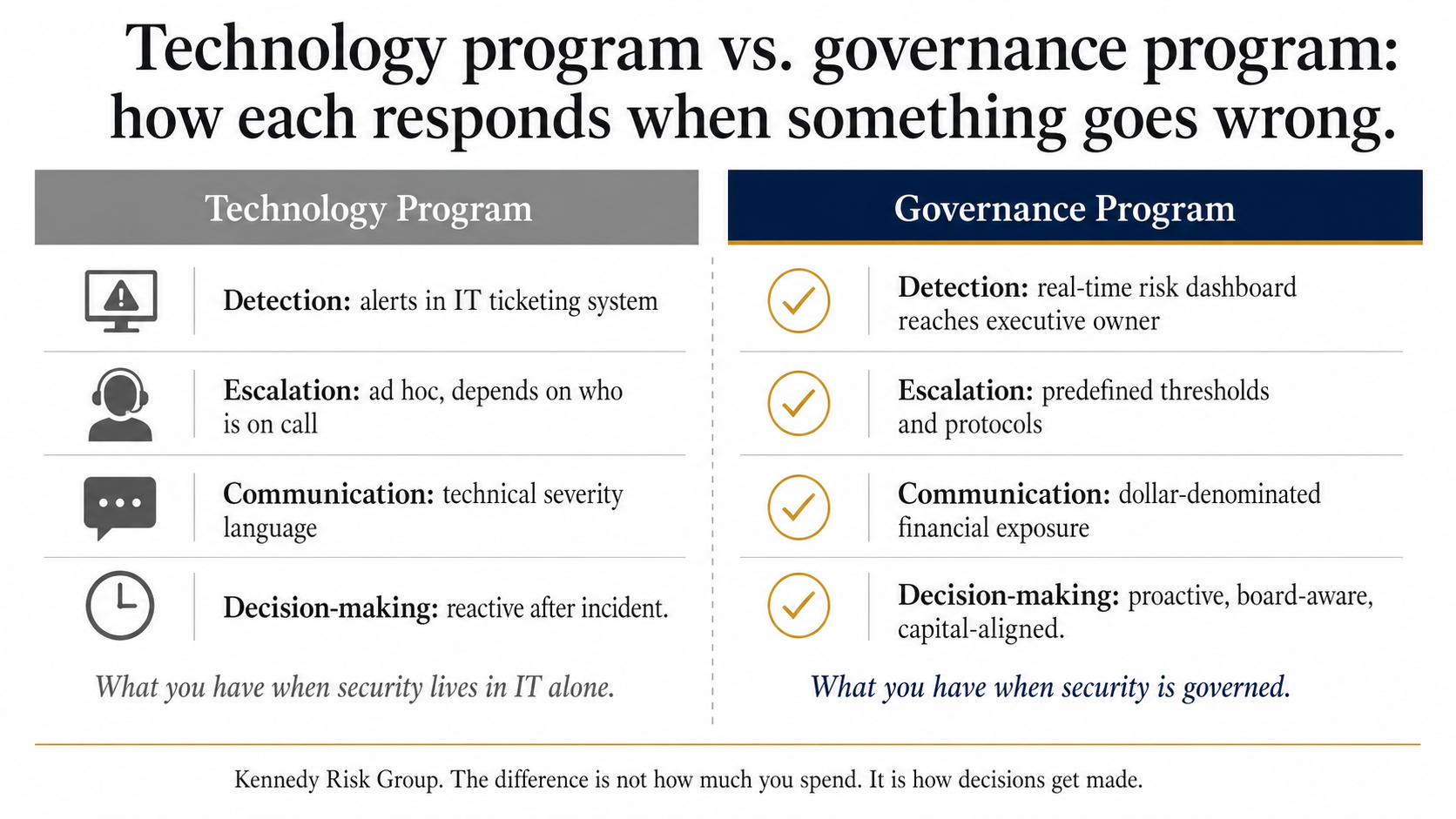
Two program designs. Two very different outcomes.
If your organization's security posture depends entirely on what your IT team has deployed, you have a technology program. You do not have a governance program.
The difference shows up when something goes wrong: in how fast it escalates, how clearly the financial impact is understood, and how confidently leadership can communicate to the board, to lenders, and to customers.
If you are unsure whether your security risk is governed or just managed, that is the right question to start with. Kennedy Risk Group's ERM Program Diagnostic is designed to answer exactly that, identifying where your governance structure supports your risk exposure and where it leaves you exposed.
Start with clarity. Build from there.
Key Takeaways
- Corporate security fails at the governance level long before it fails at the technical level. Buying more tools does not close that gap.
- Most mid-market organizations treat security as an IT function when it belongs at the executive governance level.
- The three governance gaps that create exposure: no named executive owner, no structured escalation, and no financial quantification of risk.
- Mid-market companies face enterprise-level regulatory exposure without enterprise-level governance infrastructure.
- The shift from technology program to governance program requires named accountability, defined escalation, and dollar-denominated risk exposure.