Enterprise Risk Management
How to Run a Business Impact Analysis: Set Recovery Priorities
Work backward from a missed commitment to find the latest usable recovery time. A shipping example shows why the system can be back and the orders still late.
By Eric Kennedy · Originally published Thu Nov 26 2026 · Updated Thu Nov 26 2026 · 7 min read

A carrier can leave on time while your orders are still on the dock. In the illustrative scenario below, the truck leaves eight hours after an outage begins. The warehouse can process orders by hand. Even so, if the order system comes back at hour six, 90 priority orders miss that truck. Getting the system back was not the same thing as getting the work done.
A business impact analysis (BIA) tells management which work must resume first, at what minimum capacity, and why. Start with a commitment someone outside the recovery team depends on. Work backward through the last handoff, the waiting work and the people or systems needed to finish it. The result should be a recovery order that a CFO can fund and an operator can challenge.
Start with the promise, not the application
Ask the person who runs the shift: “What is the next thing we would fail to deliver, to whom, and at what time?” A useful answer names an output. “Release the approved payroll file before the bank stops accepting it” gives you something to verify. “Payroll is critical” gives every other department permission to say the same thing.
Bring the evidence to the meeting. For a payment, that might be the bank's acceptance schedule and the last file acknowledgment. For an order, use the carrier booking, the dock manifest and the last several shifts' release times. Establish whether the stated deadline is a contractual cutoff, an internal preference or simply the time people are accustomed to finishing. Ask who can extend it and whether that person will be reachable during the disruption.
Record what happens on each side of the cutoff. A late receipt can shift cash into the next day without turning the invoice amount into a permanent loss. An extra pickup may cost money without costing a sale. Keep delayed cash, incremental expense and lost margin on separate lines. If customer harm or a safety constraint governs the decision, write it down in its own terms. A low dollar estimate is not permission to ignore it.
Get the clock and the unit right
Use the same start time for business, technology and supplier estimates. If IT starts its recovery clock at incident declaration but the business counts from the first failed transaction, someone must account for the interval between them. “Restored” should mean the operator can complete an accepted transaction with the right access and data. A healthy server is not evidence of that.
Peak timing matters. The UK's Financial Conduct Authority, in its 2021 operational resilience policy, Appendix 1, SYSC 15A.2.8G, calls attention to fluctuations in demand when setting an impact tolerance. That is financial-sector guidance, not a rule for every mid-market company. The useful question for a manufacturer or distributor is concrete: would the answer change on the last shipping day of the month?
NIST's contingency planning guide provides a BIA template for evaluating information-system recovery priorities. Its scope is federal information systems. Use it to organize dependencies, not to borrow a target for your business. Neither source tells you how many orders a particular shift can release by hand. Measure that in accepted orders per hour, after exceptions and rework, not in labels printed.
Work backward from the last truck
Illustrative scenario. At the start of an outage, a distributor has a fixed queue of 390 priority orders. The carrier departs at H+8. The dock needs the final hour for staging and dispatch, so order processing must finish by H+7. The operators can complete 30 orders an hour manually from the start. Once the order system is usable, the team processes 120 an hour in total, not 120 in addition to the manual rate. No new orders enter this priority queue.
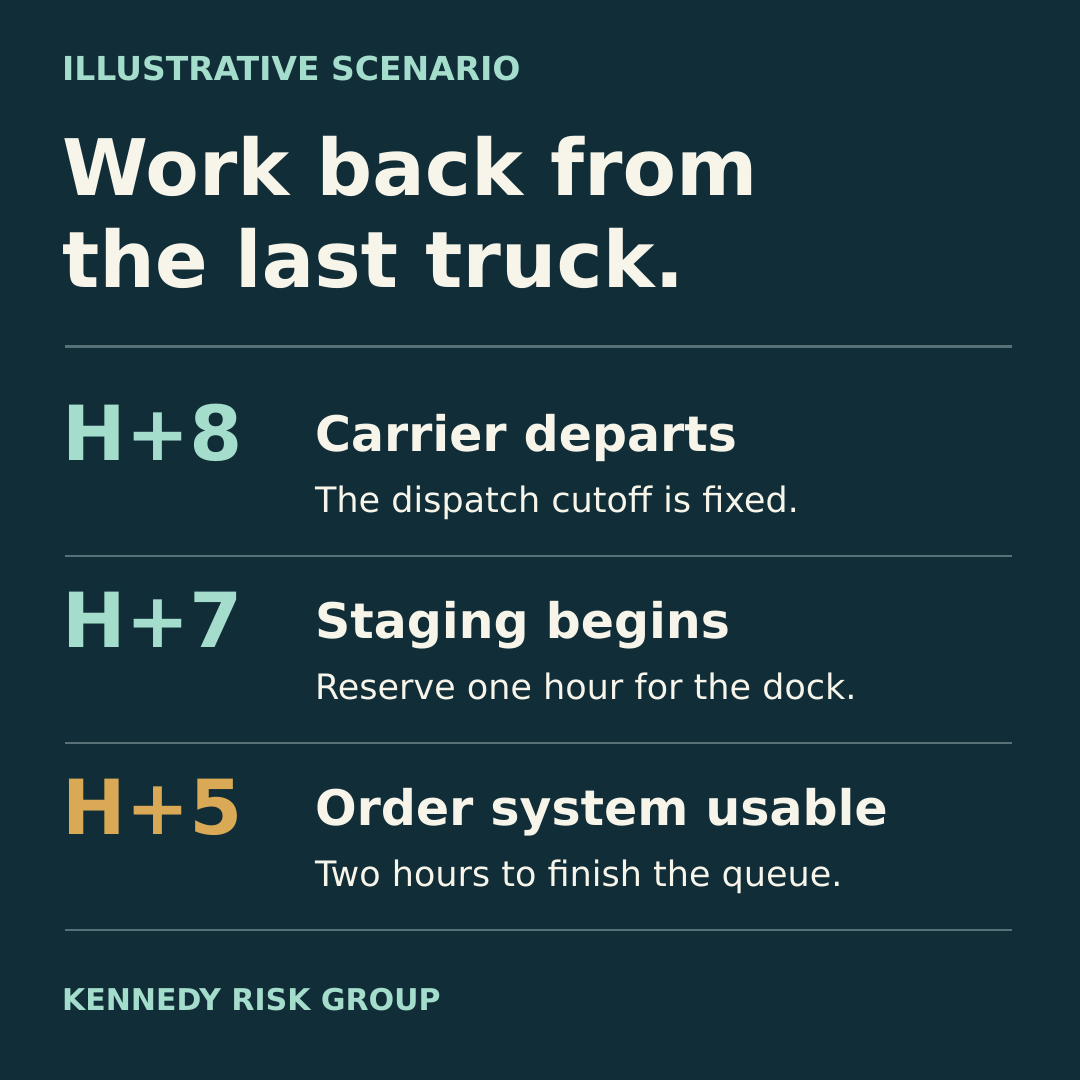
The carrier owns the last departure. The dock owns the hour before departure. That leaves seven hours for processing, only part of which can run at the slower rate. If the system is usable at H+5, five hours of manual work completes 150 orders. Two hours at 120 completes the remaining 240. All 390 are ready when staging begins. There is no buffer.
At H+6 the arithmetic changes: 180 manual plus 120 automated equals 300. One hour late costs 90 orders on this dispatch, not necessarily 90 lost sales. The difference is the 90 orders per hour of capacity surrendered while the workaround runs instead of the restored process.
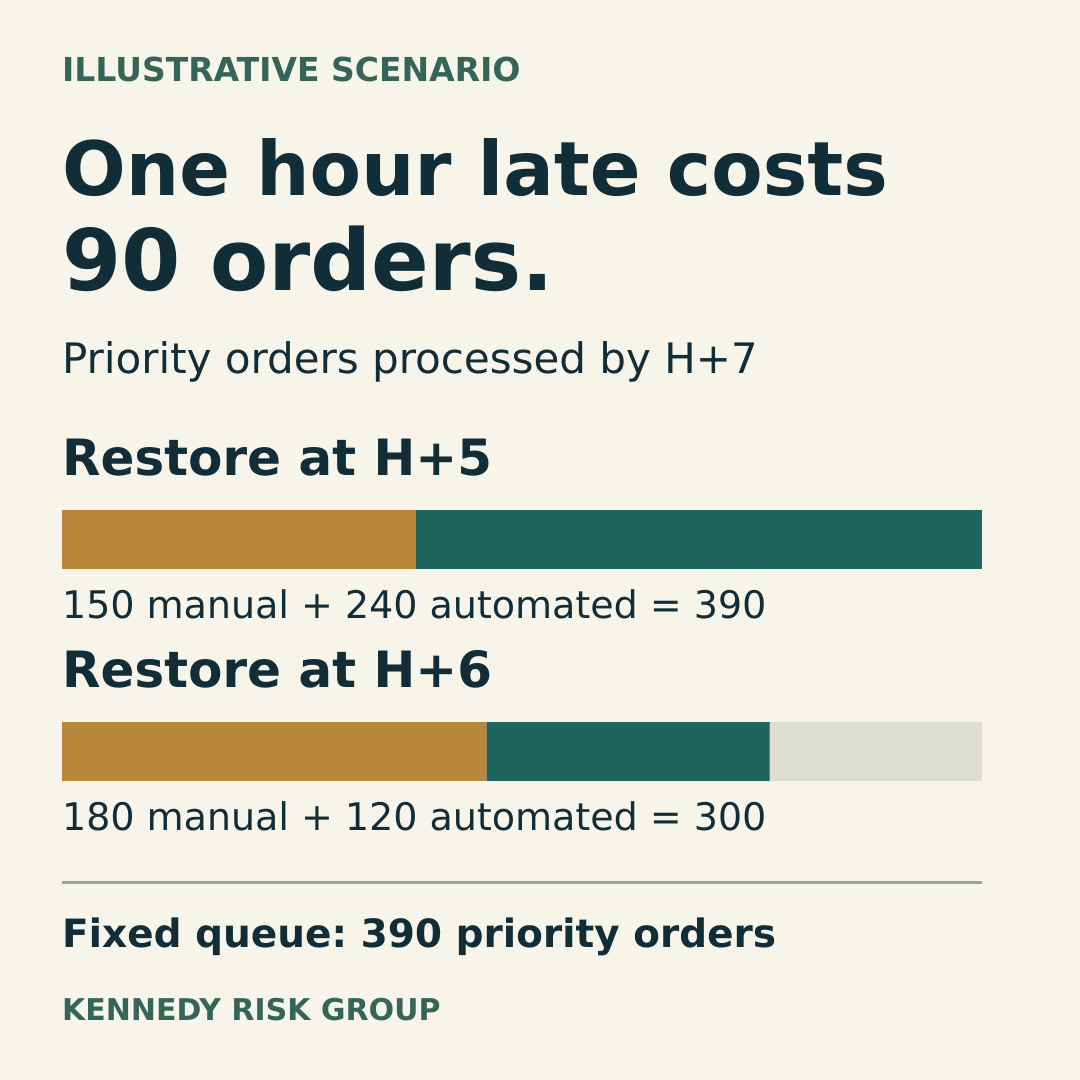
The five-hour result is a latest usable time under the stated assumptions, not a prudent operating target. If restored orders need reconciliation before processing starts, reserve that time too. If the same people must start staging early, they cannot keep processing at full speed. A short timed run will tell you more than another round of voting on whether the warehouse deserves the highest priority.
Decide what moves when the target cannot be met
Take the measured capability back to the person who can change the commitment. In the shipping scenario, if six hours is the best supported recovery time, management has a 90-order decision. A later pickup only closes the gap if the carrier agrees and the staff can finish the handoff. A second manual station only helps if it can work from a reliable queue without issuing duplicate releases. Ask for the test or confirmation before counting either option.
Sometimes the right choice is to let some work wait. An expensive standby arrangement makes little sense for a reversible delay if a customer will accept next-day delivery at modest cost. The opposite can also be true: one low-value order may be more urgent than a full pallet if someone depends on it for safe operation. Let the person with authority make that choice before a shift supervisor has to improvise.
The recovery decision record
| Decision field | Evidence to keep |
|---|---|
| Commitment and owner | Name the recipient, output, cutoff and person authorized to change it. |
| Minimum service | Record the priority units due, accepted units per hour and last handoff. |
| Dependency and latest usable time | Name what must work, who verifies it and the time still needed afterward. |
| Capability gap | Compare the required time with a timed test or a documented supplier commitment. Label untested estimates. |
| Tradeoff and decision | State what waits, who bears the impact, who can approve it and when the assumption will be tested. |
Give two owners competing for the same recovery team a copy of that record. Ask each what happens if the other process goes first. Prioritize the commitment with the earlier intolerable consequence after realistic workarounds. If both still fail, the decision for management is about capacity or commitments, not which row gets colored red.
Test the assumption that changes the answer
Before funding a faster restore, identify the one input that would change the decision. For the distributor, test the manual pace with the actual shift, including its process for unsellable stock, duplicate orders and missing authorizations. Use a safe test set and reconcile accepted output. Don't assume last year's demonstration with the most experienced operator reflects a holiday shift.
Use the business continuity tabletop exercise to test the handoffs once the owners have agreed on priorities. If you're reviewing a plan independently, the business continuity audit guide covers what evidence to examine. The BIA supplies the business requirement; neither the analysis nor a successful discussion proves the operation can meet it.
For the executive report, put the deadline, tested capability, remaining gap and decision on one page. If your current report tells the board only that continuity is “amber,” use the scorecard to check whether it tells directors what might miss its deadline and what management needs to decide.
Take the Risk Reporting Scorecard
Frequently Asked Questions
Who should own a business impact analysis?
The person accountable for delivering the service owns the impact assumptions. Finance checks the money and timing, operations tests the workaround, and IT or the supplier confirms what it can restore. An executive resolves conflicts when two services need the same scarce resource.
Is the business deadline the same as the system recovery target?
No. The deadline is when a commitment must be met. A system may have to be usable much earlier so people can reconcile records, clear waiting work and complete the handoff. Measure those intervals before assigning the system a target.
What if the business needs faster recovery than the supplier offers?
Record the gap as an open management decision. Test a workaround, reduce the work due before cutoff, negotiate a different commitment or explicitly accept the remaining impact where management has authority. Do not record the required time as a capability the supplier has demonstrated.